
Franz Schreker’s Der Schatzgräber premiered in Frankfurt in 1920. It was his last and most successful opera but it disappeared from the repertory under the Nazis and performances have been rare since WW2. Christof Loy directed it for Deutsche Oper Berlin in a new production in 2022, marking the 100th anniversary of the first performance in Berlin. It was also a continuation of Loy’s project of bringing less well known opera with “strong female characters” to DOB, following his production of Korngold’s Das Wunder der Heliane and Zandonai’s Francesca di Rimini.

It’s a strange opera in several ways. It has a sort of magical plot. Set in some imaginary kingdom, the Queen is wasting away because her fabulous jewels have been stolen. The Fool tells the King of a mysterious musician who has the power to unearth lost treasures. Meanwhile, Els, a waitress, is collecting the lost treasure by having unwanted suitors bumped off while buying it. Elis, the musician, shows up with the most prominent part of the treasure, a necklace, which he has found in the forest. Els’ latest fiancé is found dead and it’s assumed that Elis must have murdered him and is sentenced to hang. The Fool shows up and realises that Elis is the man the king needs so arranges a reprieve. In an attempt to cover her tracks Els has her sidekick (and fiancé murderer) Albi, steal Elis’ magic lute.
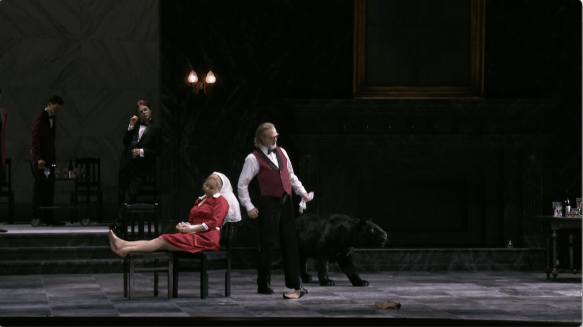
By this stage the Fool is in love with Els and Els and Elis have also fallen in love. Els promises Elis a night of love after which she will give him the jewels as long as he doesn’t ask where she got them. The Queen has her jewels back and is restored. Elis is knighted. The bailiff arrives with the news that he has tortured a confession out of Albi who has implicated Els. Elis is revolted but the Fool demands Els as his wife; saving her from being burned as a witch. This doesn’t turn out so well as Els now wastes away instead of the Queen. Elis returns in an attempt to save her but she dies anyway. Elis disappears leaving the Fool devastated.

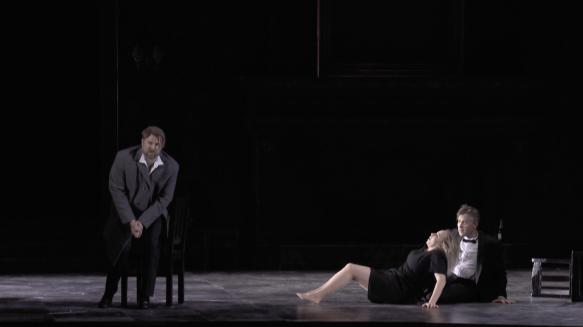
Loy’s production is quite a straightforward affair. It’s in modern dress but follows the plot fairly literally. He does use dancers around the action to suggest an audience for everything that happens and there’s some ambiguity between what’s real and what’s a dream. In particular the Act 3 “night of love” is staged as a rather surreal orgy involving the Queen. This is quite effective as the music; reminiscent of the love duet in Tristan und Isolde, certainly suggests a lot more going on than the libretto does.

The music is pretty much of its time. It’s mostly high late Romantic with lots of Wagnerian elements including some use of Leitmotif but it does go off in different directions at times. For example, after the orgy in Act 3 the jewel scene sounds more impressionistic; a bit like Debussy perhaps. There are also two distinct vocal styles; a rather dry one that carries most of the narrative plus something more melodic for Els and Elis when the action suggests they are singing; Elis after all is a musician and at times he almost seems to be singing the action into being..

It’s a large and rather peculiar cast. There are five tenor roles; including the Fool and Elis, and six for low male voice; including the King. There’s only one female singing role; Els, a soprano. The Queen is a non-singing role taken here by a dancer. In the recording there’s nobody particularly famous but the leading roles are done very well. Daniel Johansson has a near Heldentenor quality as Elis and he’s well matched by Elisabet Strid’s even toned and quite hefty soprano. Michael Laurenz is very effective as the Fool. It’s not a showy singing role but he handles it well and is a good actor. Much the same is true of bass-baritone Tuomas Pursio as the King. The rest of the cast is consistently good and Toronto folks may spot Joel Allison in the relatively small role of the Mayor. The chorus is pretty good and the orchestra produces an appropriately opulent sound. Conductor Marc Albrecht goes for the full Romantic thing and gets it.

It’s pretty straightforward to film; apart from being quite dark in places and Götz Filenius captures it well. It looks and sounds (the usual PCM stereo and DTS-HD-MA) fine on Blu-ray. The booklet is quite useful as, besides a track listing and synopsis, it features an interesting interview with Loy and Albrecht that certainly helps get to grips with a pretty unfamiliar piece. Subtitle options are English, German, French,Korean and Japanese.
I don’t think I’m as convinced as Albrecht and Loy that this is a great opera. It’s very much of it’s time and the Zeitgeist seems rather at odds with today but it is of some interest and the DOB version presents it well.
Catalogue number: Naxos Blu-ray NBD0173V
 operaramblings
Here in Frankfurt we had an elaborate production of Der Schatzgräber in 2002, conducted by Jonas Alber and directed by David Alden.