
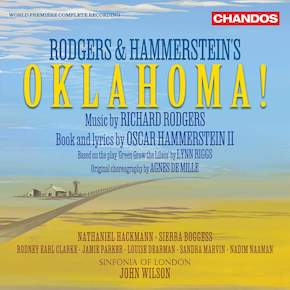
 So, you may ask, what is Opera Ramblings doing reviewing a recording of Rodgers & Hammerstain’s Oklahoma!? Well, it’s a project in the same vein as my reviewing the Bru-Zane recordings of more or less forgotten late 18th and 19th century French operas. It’s an attempt to put the piece in the context of its early performances and also to look at how it was originally performed for, like many early 19th century French operas, if and when Oklahoma! does get performed it’s usually in a style very different from the original The occasion for doing so is a new Chandos recording that attempts to reconstruct the sound of the original 1943 Broadway run. That the recording is very high definition and released in SACD format only increased my interest.
So to history. Oklahoma! opened on Broadway in 1943 and it was the first Broadway musical show to be based on a play with a real story. Previous Broadway shows had essentially been “revues” in which song and dance numbers linked by the flimsiest of romantic plots were the norm. So it really is the first of the line of what most people think of as the “classic musical”:; South Pacific, The King and I, My Fair Lady etc, etc.
It was also performed with production values that have rarely been matched in revivals. For example, there’s a lot of ballet and a proper choreographer was used. The orchestra is large for a Broadway show; 16 strings (6.4.2.2.2) and double woodwinds which means that the whole of the oboe family makes an appearance at some point. This is the line up used on the recording with actual 1940s guitar and drums used too. The singing was unamplified and so it sounds more operatic. On the recording this is particularly true for Curly and Laurey, sung here by Nathaniel Hackmann and Sierra Boggess but the rest of the cast is good too. It seems to me that this marks a kind of short lived convergence between some of what was going in the opera world and Broadway that was quickly lost as opera, for a time at least, pretty much ditched tonality and the musical moved off in the direction of smaller pit bands, amplification and convergence with other popular music trends. So by the 1970s one could have Joseph and the Amazing Technicolour Dreamcoat playing at one of The Strand and Henze’s We Come to the River at the other.
Besides using the complete original orchestration, the recording is also presented complete (At least as far as music goes. There’s no dialogue.) so all the ballet music, and there’s a lot; 16 minutes at the end of Act 1 for example, is included. It’s very well done. Conductor John Wilson has assembled an excellent cast and that most useful recording orchestra; the Sinfonia of London, and it sounds to my ears like I’d expect a proper acoustic performance of the piece to sound.
It’s helped of course by a really good 96kHz/24 bit recording made in the excellent acoustic of London’s Royal Academy of Music. The transfer to SACD is excellent. I listened to the surround mix and it’s most realistic and atmospheric. The booklet is good too with more detail on the project than I could include here plus a rather unnecessary (since every word is clearly audible) full book. So it succeeds in what it sets out to do; reclaim a historically important work in the form it deserves to be heard in. It’s available in a variety of formats. There’s the physical hybrid SACD which I listened to, very expensive vinyl (no I don’t get it) plus MP3, standard and hi-res FLAC. As always, I’m going to advise going for the SACD if you have the necessary gear.
And now a digression… Oklahoma! is, ultimately, about the creation of the state of Oklahoma in 1903. It’s remarkable how the musical, and presumably the play it’s based on, completely manages to gloss over issues of race and class. I know they are the two great taboos of American discourse but still. Take for the example the Act 2 number “The Farmer and the Cow Man Should Be Friends”. Like every other settler colony I know of ranchers and farmers in the US represent quite different class interests. The farmer is essentially a peasant. He and his family, often drawn from the poorer parts of Europe, scratch an existence in really rough conditions (see Mizzoli and Vavrek’s Proving Up for an operatic take on that). The rancher has usually obtained a sweetheart lease on state or federal lands through the usual means one does that, is connected, from the dominant ethnic group and has capital and employs wage labour. If GBS’s view that class is essentially about endogamy then no way his daughter is marrying a peasant as the song suggests. But perhaps the “cowman” refers to the wage labourer or “cowboy” as he is romantically known. Well in the real world he didn’t look much like John Wayne. Chances are he was black or hispanic because no-one else wanted the work (the same of course for the US Cavalry as Bob Marley pointed out). And even a poor European hard scrabble farmer isn’t going to marry his daughter to one. But it’s 1943 and it’s war time so national unity must be preserved. And it is, by the usual means of ignoring the obvious and excluding anyone outside the mainstream. </digression>
Returning to the recording, if you like this style of musical I think it’s a must have. Even if, like me, it’s not really your bag this is a very well done and historically important release that you might want to take a look at anyway.
Catalogue number: Chandos CHSA 5322(2)
 operaramblings
Who ever thought that the “historically informed performance” trend would reach the American musical! I led the orchestra for my high school’s production of Oklahoma! when I was in Grade 13 and couldn’t get the tunes out of my head for many, many months afterwards. I look forward to the waves of nostalgia which listening to this new recording will no doubt induce…
It is intriguing. It’s still not really my thing but I’m glad I listened to it.