
Humperdinck’s second “fairy tale” opera; Königskinder, is unusual in that, although it includes traditional fairy tale elements, it isn’t based on a traditional fairy tale but rather on a play by Else Bernstein-Porges. It’s, of course, also performed much less frequently than Hänsel und Gretel. It was given at Dutch National Opera, in a production by Christof Loy, in 2022 and recorded for video release.
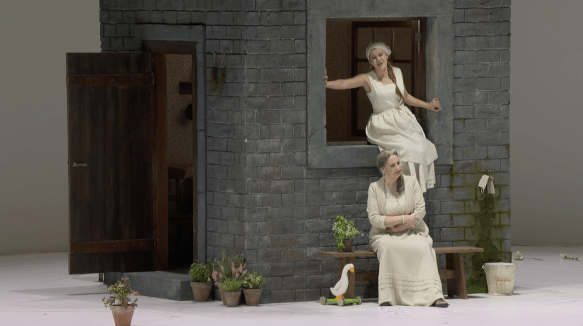
It’s rarity so here’s a brief plot summary. The goose girl and her “grandmother” live an isolated life in the Hellawald, outside the town of Hellastadt whose inhabitants the “grandmother”, who is also a witch, hates. A prince arrives from over the mountains. He is trying to learn about “ordinary people” so that he will grow up to be a wise king. He falls in love with the goose girl but neither quite have what it takes to overcome the difference in class/status. Meanwhile the people of Hellastadt have decided that they need a ruler and have sent a fiddler, a woodcutter and a broom maker to consult the witch. She tells them that their rightful ruler will be the first person to enter the town at noon the following day. The broom maker and woodcutter rush off with the news but the fiddler stays. The goose girl laments that she can’t marry above her station. The fiddler explains that she is actually the daughter of the Hellastadt hangman’s daughter and his assistant, conceived on the evening before his execution for murder. Apparently this makes her equal to royalty so she goes off with the fiddler to find the prince.

Meanwhile the prince has arrived in Hellastadt where he is taken for a beggar. The innkeeper’s daughter tries unsuccessfully to seduce him and he becomes the innkeeper’s swineherd. At noon the goose girl enters the town and claims the prince. The townspeople are horrified that they are to be ruled by a beggar and his girlfriend. They drive them from the town. Only the children and an elderly counsellor realise that they are, in fact, the promised royal couple.

Back in the Hellawald the witch’s hut stands empty. She has been burned at the stake for false prophecy and the fiddler has been beaten up and crippled. It’s winter. The fiddler takes over the hut. The broom maker, the woodcutter and the children arrive bearing the news that Hellastadt is beset with plague and famine. The children urge the fiddler to return and set things right. He refuses but agrees to help them find the royal couple. The wood cutter and the broom maker see what they can pinch from the witch’s hut. The royal couple arrive hungry and exhausted but the two baddies refuse them any help. Eventually the prince trades his crown for a loaf of bread. The goose girl recognises it as an enchanted/cursed loaf that she baked with the witch and knows that it will both make the prince deliriously happy and kill them both. Which it does. The fiddler returns with the children to find the corpses and asks only that the children should continue to spread the hope that he no longer believes in.
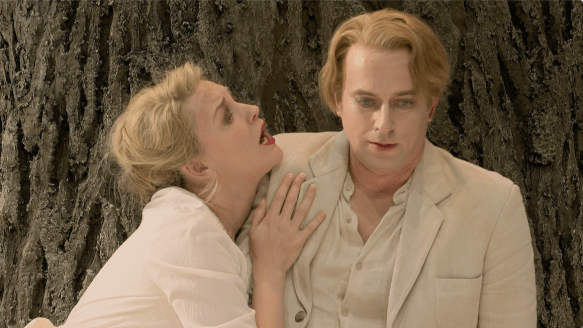
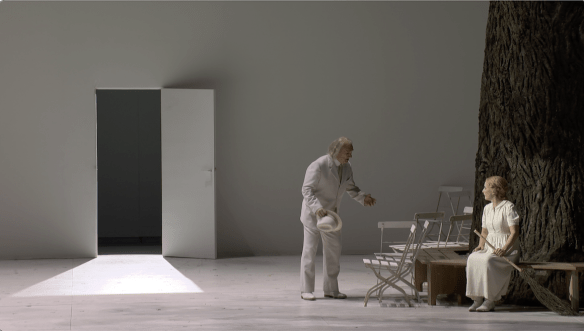
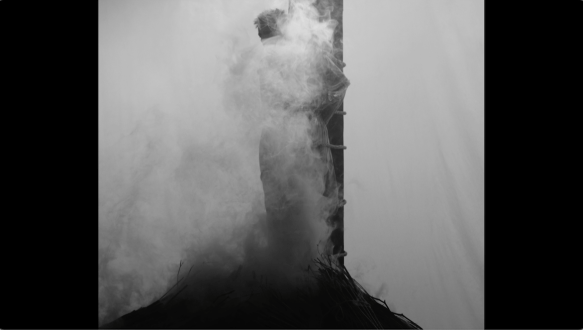
Loy’s production is quite straightforward but well thought out. The set is quite plain. In acts 1 and 3 for example there’s just the hut and a tree and act 2 isn’t much fancier. Everyone is dressed in light colours which match the set. The only exception to this are a group of dancers who are used at intervals to help define the mood. At the beginning they are colourful and energetic but in act 2 they change into white to match the townspeople then at the very end they appear in sombre mourning clothes. The only other directorial innovation is that there’s a silent black and white film playing during the act 3 prelude. It shows the events that happen between acts 2 and 3 such as the trial and execution of the witch and the beating up of the fiddler. It’s good and serves to reinforce the sheer nastiness of the townspeople en masse.

With a simple straightforward setting much turns on the performances and they really are very good. Daniel Behle, as the prince, and Olga Kulchynska, as the goose girl, make a really attractive couple. The voices blend nicely and they have excellent chemistry. They are well supported by Josef Wagner’s fiddler. He’s a fine actor and has a firm but very attractive baritone which works nicely with the higher voices. There are excellent cameos from Sam Carl as the woodcutter and Michael Pflumm as the broom maker. They do a great job of portraying two very unpleasant people; from being the snivelling cowards of act 1 to the town bullies later on, with their sheer nastiness of their characters reinforced by the silent movie. Doris Soffel is rather good as the witch, exuding a sense of being thoroughly fed up with everyone and everything. But perhaps the best cameo is Isobel Houtmortel’s as the broom maker’s daughter. She is effectively leader/spokesperson of the children and she has quite a lot to sing. She’s very young but the pure tone she conjures up sounds even younger and she’s just very, very sympathetic. There’s a bunch of minor roles and all are well done and the chorus of Dutch National opera backed up by the children of Nieuw Amsterdams Kinderkoor do a fine job.
This is Humperdinck so the orchestral writing is lush and colourful. It’s really good. It’s played very well by the Netherlands Philharmonic and conductor Marc Albrecht brings out its qualities without overwhelming the singers at all. It’s helped by the really good sound on Blu-ray, especially the hi-res stereo mix. Listening on headphones I was struck by just how detailed the recording was.
It;’s not a difficult production to film and Michael Beyer presents it well. The picture is excellent on Blu-ray and would probably, in this case, be fine on DVD too. The booklet has a synopsis and a full track listing plus a few paragraphs about the work and the production. Subtitle options are German, English, Dutch, Japanese and Korean.
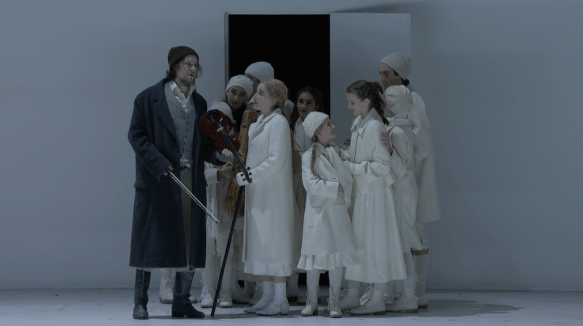
This is the only video recording of Königskinder and it makes a pretty good case for it. The work is musically interesting, this production works and the performances are excellent.
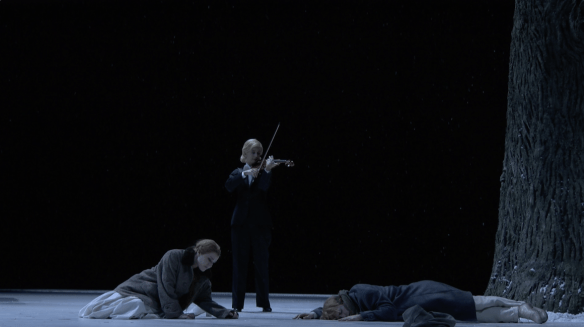
Catalogue number: Naxos Blu-ray NBD0171V
 operaramblings