
It’s probably not ideal to begin the review of a new Ring cycle with Götterdämmerung but in the case of the cycle directed by Valentin Schwarz that premiered at Bayreuth in 2022 Götterdämmerung is the first to be released on video. Fortunately the generous two Blu-ray disk package includes a narrated summary (in English and German) of the whole cycle as seen by the director so it’s possible to put Götterdämmerung in context
I won’t try to summarize the whole cycle but I do think it’s important to delineate what has happened previously that affects Götterdämmerung directly. The first, and vital, point is that this is a wholly human telling of the story. There are no gods, dwarves, giants or dragons. Wotan is the patriarch and CEO of some kind of family enterprise. He’s over extended himself and owes big time to his architects Fafner and Fasolt. The Rheingold is symbolised by a child who is kidnapped by Wotan’s half brother Alberich but is retrieved with the help of the family lawyer Loge. The boy grows up with Fafner to become Hagen.

When Siegfried shows up at Fafner’s lair the old man is dying and finally croaks when he sees Siegfried. Siegfried and Hagen temporarily team up to kill Mime but Siegfried dumps him when his interest shifts to Brünnhilde. Hagen wants revenge.
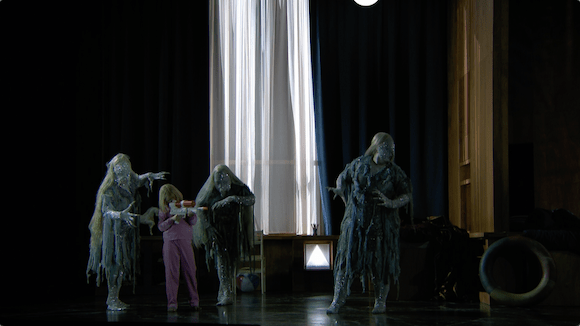
As Götterdämmerung begins Siegfried and Brünnhilde are living together and have a child. This child now symbolises the Rheingold. Brünnhilde reads the child a bedtime story which causes it to have a nightmare in which the Norns appear and do their thing. Hagen is lurking. Siegfried sets off Rheinfarting taking Grane with him. This Grane is not a horse but rather Brünnhilde’s elderly man servant.

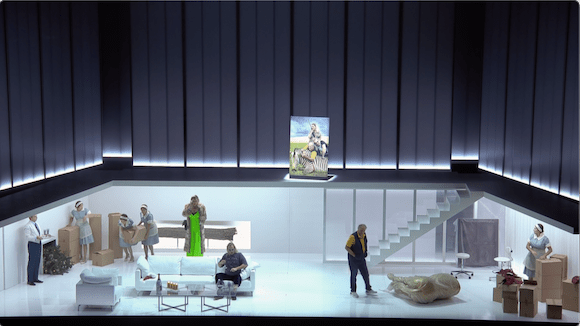
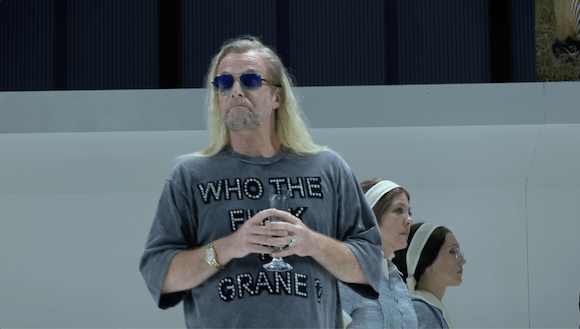
The Gibichungs have moved into Valhalla which has apparently been sold ff by Wotan. They have redecorated in vulgar nouveau riche style including a large photograph of the three of them posing with a zebra they have shot. Gutrune is seriously overdressed and doing coke. Gunther clowns around rather revoltingly. He’s wearing a tee shirt that says “WHO THE FUCK IS GRANE?” in sparkly letters. Siegfried arrives with Grane carrying the suitcases. Grane then has green slime poured over him and he’s taken away. When we next see him he’s covered in blood n a gurney and Hagen is wearing surgical gloves. This will come back to haunt us.
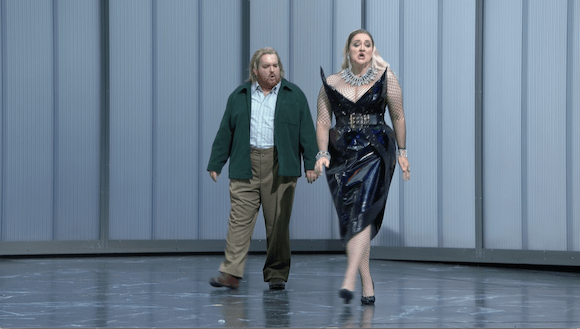
The Waltraute scene is quite well done in a rather overwrought way but the “impersonation” of Gunther by Siegfried is about as unconvincing as it usually is reinforced here by a rather nasty undercurrent of rape and child abuse. Perhaps unsurprisingly here’s a lot of booing when the curtain finally falls on Act 1.

Act 2 is pretty much as weird. Hagen and Alberich (who bizarrely carries the supersoaker that the child had in the prologue) spar with boxing gloves. The chorus of Gibichungs wear hooded robes and carry masks that seem to be derived from the Lewis chess set. Otherwise, as these things go, Act 2 is fairly straightforward.

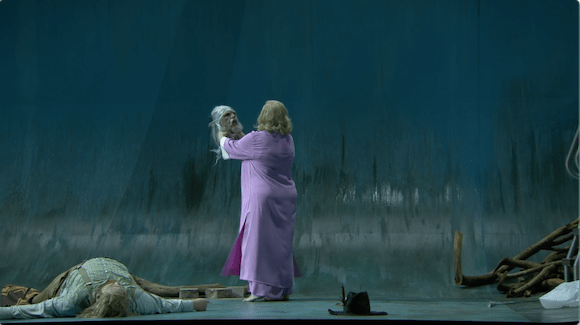
Act 3 though is very odd. It’s set in an empty swimming pool. Siegfried is fishing with the child but there isn’t any water to speak of. A rather raddled set of Rhinemaidens appear and fail to seduce Siegfried. Gunther and his henchmen show up very drunk and Hagen kills Siegfried. There’s no funeral procession. Siegfried will stay where he is on the bottom of the pool for the rest of the opera. Brünnhilde shows up with the child and the Rhinemaidens wearing “chess” masks. Gunther descends into the pool and throws down a plastic bag which we soon learn contains Grane’s head. She descends into the pool and sings her last few minutes of music to the head (shades of Salome). She then lies down next to Siegfried. By this point the Rhinemaidens have left and the child has inexplicably dropped dead. Hagen sings his one line and departs.
So now we have Siegfried, Brünnhilde and a severed head lying in an empty swimming pool. Does the world end? Does Valhalla burn to the ground? Does the Rhine overflow its banks? Of course not. Some banks of lights come on across the top of the stage, the orchestra plays the big closing sequence and the curtain falls. It’s all a bit anticlimactic.
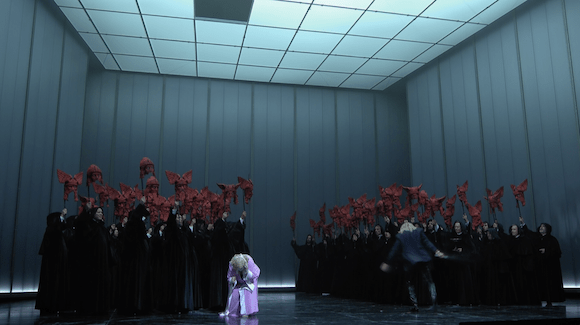
OK, so I’m not convinced at all that this production works on any level but how about musically? It’s not bad. Not top drawer but not bad. Albert Dohmen as Hagen is probably the star of the show. He acts convincingly and sings really well. Clay Hilley, standing in at short notice for Stephen Gould, shows once again that he’s one of the best Siegfried’s around with helden heft and ringing high notes. Elisabeth Teige as Gutrune probably out-sings Iréne Theorin’s Brünnhilde and certainly out acts her (we’ll come back to that). Michael Kupfer-Radecky’s Gunther is appropriate to the production (i.e revolting) and he sings well. There’s a very nice cameo from Christa Mayer as Waltraute. The Norns and Rhinemaidens are two well balanced trios. The weak link is Theorin. At times she’s quite lyrical and at others quite harsh. It might have been deliberate I suppose but i don’t think so and neither did the house audience. She actually got booed at curtain call (though on nothing like the scale of what hit the production team). The orchestral playing is excellent and Cornelius Meister’s reading of the score is decent if not exactly in the class of Thielemann or Boulez.
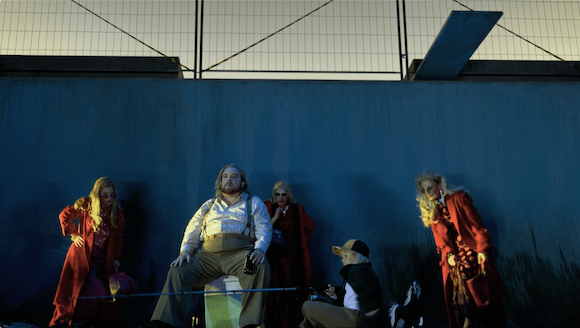
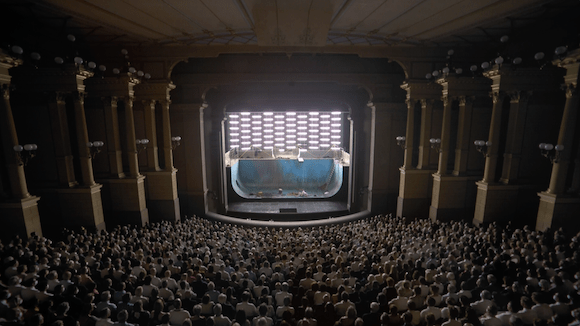
Michael Beyer’s video direction is straightforward except for the very end when he seems at a loss what to do with the sheer nothingness. His solution is to show the whole theatre with the stage tiny in the distance. Then he gets bored with that and switches to a shot from, I think, the beginning of Rheingold where Alberich and Wotan are fighting in their mother’s womb. It’s really hard to give two people and a head lying motionless in a dry swimming pool an effective cinematic treatment.
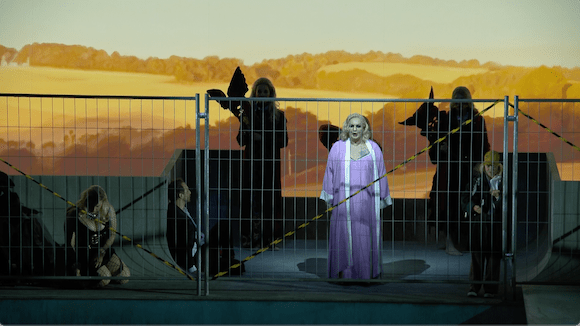
The disk package is pretty good. It’s spread over two disks so there’s no need to compromise on the surround sound to make it fit (as in the Deutsche Oper Berlin recording). In fact there are three sound tracks; hi res stereo, DTS-HD-MA and Dolby Atmos. I don’t really have the gear to take advantage of the last but it sounded as good as the other two which are excellent. Picture quality is excellent too which is important as many scenes are dark and some are hazy. The principal extra is the audio commentary referred to earlier which is pretty much essential. The booklet contains a long essay about the production. It’s a sort of apologia sort of based on the idea that all Wagner’s dramatic ideas are contained in the music so one can do what one likes with the staging. It’s true up to a point I suppose but I’m not completely convinced. There’s also a full track listing. Subtitle options are German, English, French, Spanish and Japanese.
I really can’t sum up this production better than the Guardian which said “The Schwarz cycle ran out of steam in the end because it had no big or unifying idea – not even a really bad unifying idea such as Frank Castorf’s pretentious 2013-17 Bayreuth Ring which preceded this one.” There really are some very good video recordings of the Ring which far surpass this one around so I would say that this is for the Bayreuth completist or the masochistic.
Catalogue number: Deutsche Grammophon Blu-ray 736404
 operaramblings