
Rossini’s Il Turco in Italia isn’t performed (or recorded) all that often despite being well constructed and amusing in a thoroughly silly way. Perhaps it’s just too difficult/expensive to cast? It requires a bass or bass-baritone of great flexibility plus a top notch Rossini soprano and two tenors with genuine high notes plus several other soloists. Who knows? Anyway it was given at the Rossini Festival at Pesaro in 2016 and recorded for video.
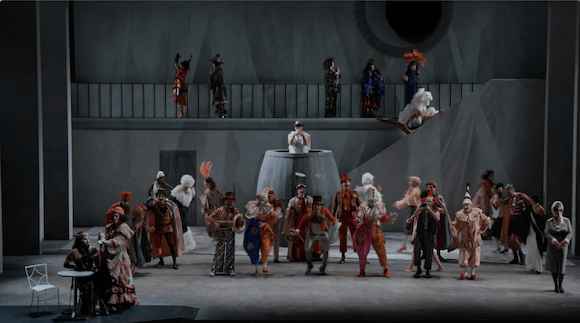
The basic plot is meta-theatrical A poet is looking for a story line for his next play when he comes across a band of gypsies. One of the gypsies is Zaida who has, in fact, escaped from the harem of the turk Selim after being accused (wrongly) of infidelity. She’s now on the run in Naples disguised as a fortune teller with her sidekick Albazar. Selim shows up in Naples, ostensibly to learn about Italian customs and falls in love with Fiorilla, the flirty wife of Don Geronio, who is having an affair with Narciso. Fiorilla plans to run off to Turkey with Selim.

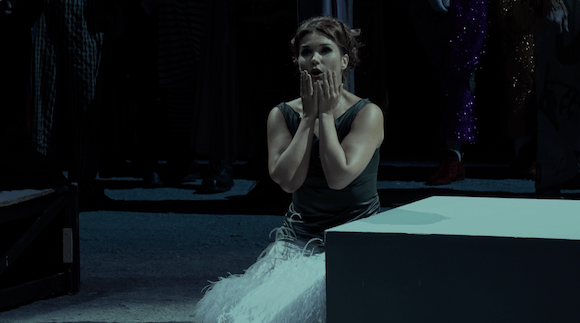
In Act 2 there’s a masked ball where Narciso, disguised as Selim, hooks up with Fiorilla while Selim partners off with Zaida, who is disguised as Fiorilla. All of this having been arranged by the intervention of the Poet who wants to keep things dramatic. Geronio shows up and mayhem ensues as he tries to deal with two wives and two rapacious Turks. The Poet intervenes to inform him that Fiorilla was having an affair with Narciso and he should send her back to her parents. This leads to a really good pastiche tragedy scene for Fiorilla in which she bemoans her fate and lost honour. Selim discovers that his “Fiorilla” is actually his lost love Zaida and reclaims her and Don Geronio agrees to take back a suitably penitent Fiorilla.
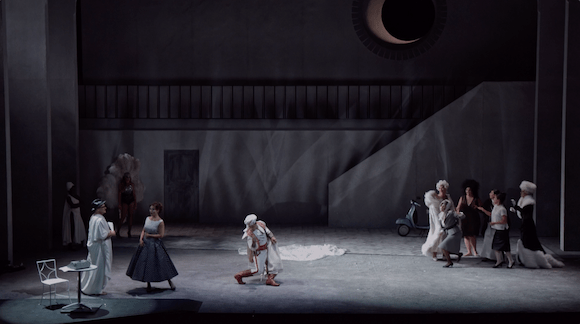
Along the way we get big choruses, flashy coloratura arias for Fiorilla and Selim and some pretty demanding tenoring for Narciso and Albazar. And, of course, multiple quick fire quartets, quintets and so on; especially the Act 2 number where Geronio is trying find his wife (or wives). It’s classic Rossini comedy.
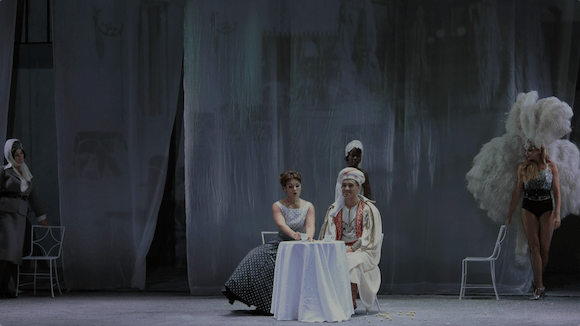
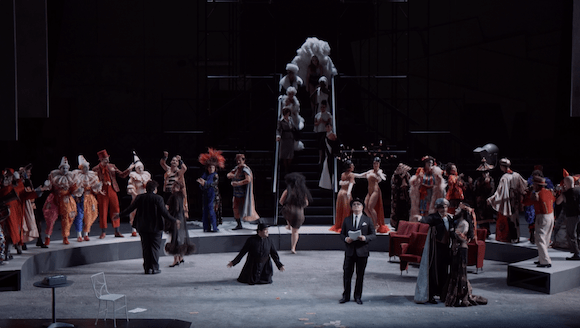
Director Davide Livermore ups the meta-theatricality by setting everything on a film set. This is a bit confusing because when we see film clips the aesthetic is clearly silent film era but the costuming for the main characters recalls Fellini. As, I suppose, do the “gypsies” who, Zaida and Albazar aside, are apparently circus people with clowns, musicians, a strong man, dancing girls etc. This also evokes Fellini but it might also be a nod to Dario Fo’s classic Amsterdam Barber of Seville. To make sure we don’t forget it’s a movie set there are cameramen and folks with clapperboards and from time to time the lighting changes so that the scene goes from “colour” to “black and white”. It’s complex but it all works pretty well.
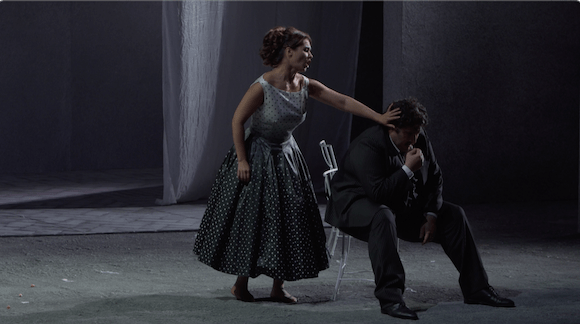
It’s really well sung and acted too. The star is Olga Peretyatko as Fiorilla. She’s got the notes and pinpoint coloratura but, above all, she’s totally believable as the young wife twisting hapless older hubbie round her finger and she gets the balance just right in the cod tragedy scene. The Felliniesque costuming is very flattering too and she really looks like she stepped out of La dolce vita. Erwin Schrott is an excellent foil as Selim. The voice is sufficiently dark and he too has the necessary agility to manage some awkward runs. And he too looks the part. A lot of the comedy comes from the interplay of Nicola Alaimo as Geronio and Pietro Spagnoli as the Poet. They work really well together. There’s some fine Rossini tenoring from Pietro Adaini as Albazar and René Barbera as Narciso. Cecilia Molinari makes a very effective Zaida (despite the Baba the Turk moustache and beard) with her darkish mezzo contrasting nicely with Peretyako’s brighter sound.

The Coro del Teatro Fortuna M. Agostini throws itself into the silliness with liveliness and skill and the Filarmonica Gioachino Rossini is excellent. Speranza Scappucci conducts and is willing to take risks with tempi. It’s not consistently super fast like her Barber of Seville in Toronto but some ensembles are taken very fast while others get a very deliberate but rhythmically pointed treatment. Good stuff.
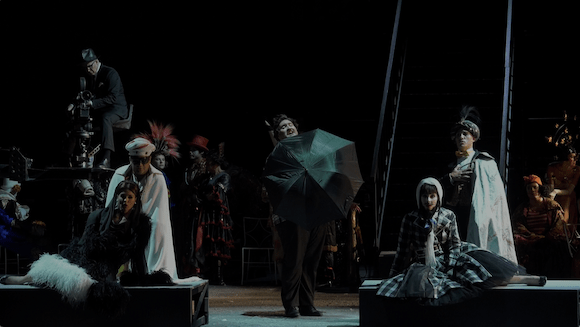
Paolo Filippo Berti directs for video. This is a tough one. There’s a lot going on and it’s often quite dark, especially in Act 2. The video projections were probably a bigger part of the experience in the theatre than on the recording but I’m not sure there’s a whole lot he could have done to reflect that. As it is it’s very watchable though definitely the sort of production one wants to see on Blu-ray rather than DVD. All things considered the picture quality is good and the hi-res stereo and DTS-HD-MA surround tracks are excellent. The booklet has a full track listing, an essay and a synopsis. Subtitle options are Italian, German, English, French, Korean and Japanese.
There aren’t many video recordings of this work and the obvious competition; Bartoli in Zurich, isn’t currently available. I think most people would be very happy with this one.
Catalogue number: C Major Blu-ray – 762604
 operaramblings