
Handel’s Theodora was conceived and first performed as an oratorio and it was a flop. closing after three performances. I’m not sure why. It may not be Handel’s best work but it’s got some very good numbers and it’s dramatically very strong.
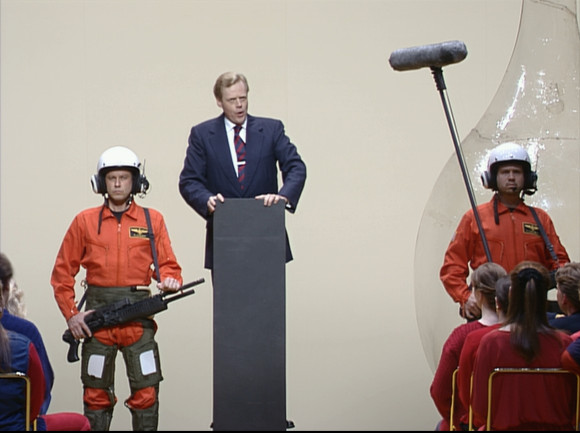 In 1996 Glyndebourne staged an operatic version conceived by Peter Sellars. Occasionally Mr. Sellars frustrates me but most of the time I think he’s a genius who stages some of the most thought provoking music theatre out there. This Theodora is pure genius. Sellars sets the piece in contemporary America. The President of Antioch, Valens, (Frode Olsen) is a typical American politician; a nasty mixture of imperialist bluster, bonhomie and crass consumerism and he’s well supported by a brightly clad coke can bearing heathen chorus. The Roman soldiers wear US Navy helicopter pilot uniforms. By contrast the Christians wear combinations of black and white in pretty restrained cuts and combinations. The set is mostly bare but for some giant shattered glass vases and, as needed, a few props such as a lectern, chairs and, most chillingly, the gurneys on which Theodora and Didymus are executed by lethal injection. It all works really well. Although conceived 15 years ago it could have been last week. The idea that one can’t be a “proper Roman/American” if one doesn’t adhere to the state and socially approved approved religion and the chilling, deadly self righteousness of Valens seem especially contemporary in a week that sees an IRA supporter chairing a House investigation into Muslim disloyalty.
 Sellars has created an acting style for the piece in which gesture is critical and not a single body movement is unscripted. It’s like watching baroque acting but with a more expressive gestural vocabulary. This is as far from “park and bark” as one could possibly get and is, I think, a crucial ingredient in the piece’s power.
 The individual performances are all terrific musically and dramatically. Olsen, as Valens, is good, especially in the opening scenes and the drunk scene that opens act 2. He has a perfectly bluff bass voice but easily handles the bravura passages. Robert Croft is equally good as the morally conflicted Septimius. David Daniels sings Didymus, the Roman officer who chooses love and death over country. He sounds more counter tenorish than more recent performances of his that I have heard but is none the worse for that. He’s a master of this kind of music and it shows. There’s also a very effective “don’t ask, don’t tell” chemistry between Croft and Daniels. That said, the real stars are the women. Dawn Upshaw in the title role is radiant. I can’t imagine the part being sung or acted better and the final duet with Daniels is heartbreaking. Lorraine Hunt is also terrific as Irene, the leader of the Christians.
 William Christie is in the pit with the Orchestra of the Age of Enlightenment and a young Harry Bicket is playing continuo. No complaints at all on the accompaniment or the pacing. All in all, I thought this one of the best realised pieces of music theatre that I have seen on disk.
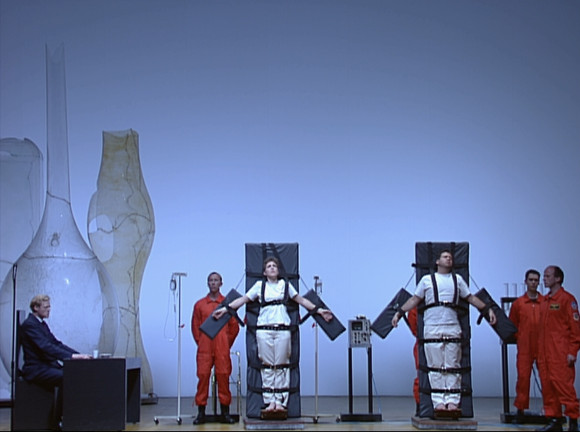 This recording was spottily available on DVD for many years but has now been remastered from the original tape and reissued on Blu-ray. The video and sound quality are distinctly better than previous DVD releases though not, inevitably, in the same class as the best modern recordings. It’s also still a depressingly bare bones release with no extras and minimal documentation but don’t let that put you off. This is one of the great opera productions of all time.
 operaramblings
Pingback: Love is stronger than death | operaramblings
Pingback: Theodora redux | operaramblings
Pingback: Staging Handel’s oratorios | operaramblings
Pingback: Another classic rerelease | operaramblings
Pingback: Going for Baroque | operaramblings
Pingback: Theodora with a twist | operaramblings