
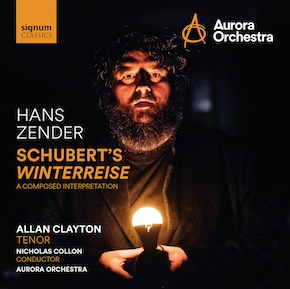
 Hans Zender’s 1993 “composed interpretation” of Schubert’s Winterreise is really interesting. It’s scored for tenor and a twenty-five piece ensemble including accordion, guitar, loads of percussion and a wind machine. It’s also over eighty minutes long with the additional material being mainly intros and outros. A new recording by Allan Clayton with the Aurora Orchestra conducted by Nicholas Conlon has just been released. It’s fascinating.
I’m just going to pick up on a few of the tracks to try and give a flavour of what’s going on. It all starts with “Gute Nacht”. Here the singing doesn’t start until almost the four minute mark after an intro including a lot of extended technique for the strings. To begin with, the singing is extremely beautiful and few singers do “beautiful” better than Clayton, then around the six minute mark it goes wild with accordion coming in and Clayton “uglifying” his voice for a minute or so before a more conventional ending.
It’s followed by a “Die Wetterfahne” that’s wild and onomatopoeic with heavy use of the wind machine. Several more conventional tracks follow with some lovely singing and colourful, tonal orchestration. “Der Lindenbaum” is particularly lovely. “Wasserflut” has an almost Wagnerian intro and gets very strident while “Ruckblick” makes extensive use of wood block percussion of some sort. There’s even something close to Sprechstimme in “Fruhlingstraum”.
“Die Post” is quite wild with lots of horn playing of course but also eerie woodwinds and in “Mut!” the wind machine sounds almost like a whoopee cushion. “Der Leiermann” is predictably quite weird but maybe not in the way one would expect. It’s the outro following. the final words which is so striking; almost alienating as if by, say, Berg. It’s a heck of a way to finish!
Specifics aside, Clayton is pretty amazing. He sings with spectacular beauty of tone. Except when he doesn’t, where he conjures up some wild and ugly and desperate sounds. Conlon’s tempi are interesting too; sometimes really slow as in “irrlicht”, at other times breakneck as in “Ruckblick”.
The recording is clear and detailed and very atmospheric, at least on the 24bit/96kHz lossless digital that I listened to. It’s also available as a two CD set, standard res lossless and MP3.
Clearly this version doesn’t in any sense replace the standard piano score version but if that’s a work you do know and love there’s every reason to listen to this new recording which will surely give you several new perspectives on Schubert’s masterpiece.
Catalogue information: Signum Classics SIGCD964
 operaramblings