
Miecysłav Weinberg’s The Idiot, based on the Dostoevsky novel, was composed in 1986/7 but didn’t get a full premiere until 2013 in Mannheim. The neglect of Weinberg’s music in USSR/Russia is probably explained by him being a Polish Jew but why he’s so little known elsewhere is a bit of a mystery as The Idiot shows that The Passenger wasn’t a fluke. Anyway, The Idiot got a second outing at Salzburg in 2024 in a rather complex production by Krysztof Warlikowski.
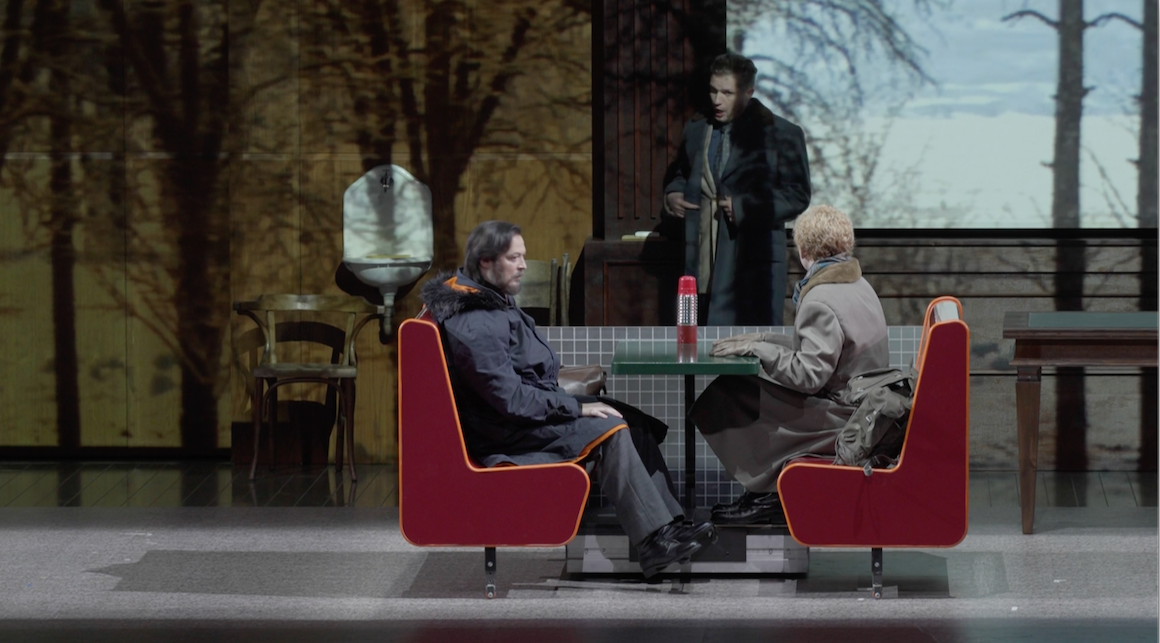
The opera tells the extremely convoluted story of a sort of love triangle (hate triangle?) between Prince Lev Nikolayevich Myshkin; an epileptic who has just returned from treatment in Switzerland, Parfyon Semyonovich Rogozhin; a rather boorish but very rich merchant, and Nastasya Filippovna Barashkova; whose exact status is a bit mysterious. She moves in society circles but there are suggestions that she’s a kept woman. Certainly she is very troubled and doesn’t consider herself a proper match for Myshkin.
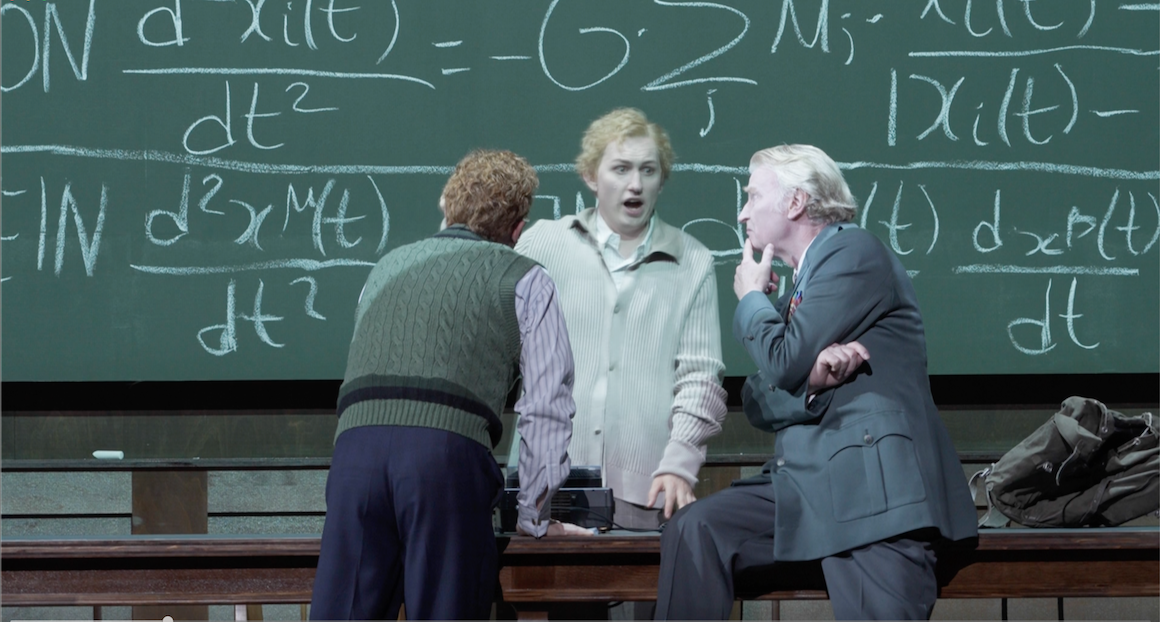
We also meet the Yepanchin family where the matriarch is trying to marry off her three daughters including Aglaya Ivanovna who clearly has her eyes set on Myshkin. The complications turn on the fact that Myshkin is a sort of “holy fool” who wants to do good but can’t succeed because he can’t be all the contradictory things the other characters want him to be. Certainly he has no intention of marrying whereas Rogozhin very much wants Nastasya but she hates him. Further complicating matters is the rather sinister Lukyan Timofeyevich Lebedev who attaches himself to Myshkin as some sort of servant. It all ends with Rogozhin killing Nastasya and persuading Myshkin to join him in bed with the dead girl. That’s a really brief summary of a complex three and a quarter hours!

Musically it’s rather good. Weinstein’s music is chromatic with, at times, lots of brass and percussion so it sounds a bit like his friend Shostakovich but gentler, more lyrical, at least most of the time. There aren’t too many showy vocal moments though Rogozhin gets a rather beautiful aria “Ah, my fate, my fate” just before the end. The orchestral writing is consistently interesting.

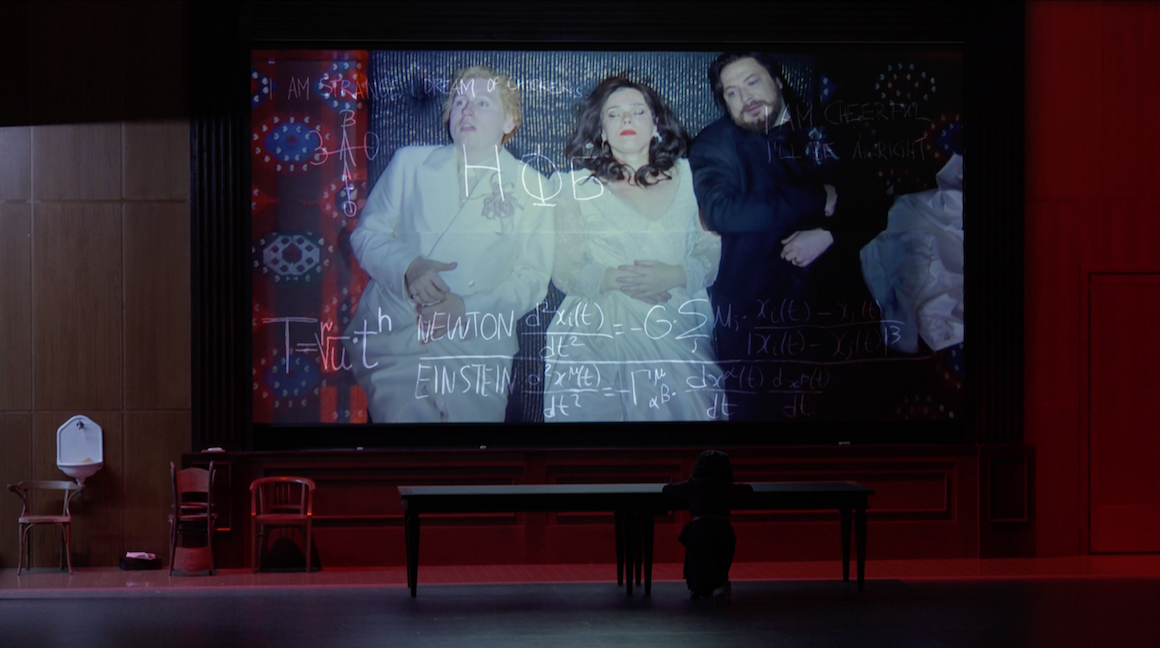
Warlikowski’s staging is fascinating. It’s the Felsenreitschule and he makes full use of the space. The stage surrounds the pit on three sides and there’s a solid back wall. One can’t see the famous arches. On this huge space he disposes several modular mini sets; often with more than one in use at a time. So we have the Yepanchin’s drawing room, Rogozhin’s house and a sort of seating area that serves as a train, a café etc. There’s also a big screen for projections though that’s certainly not the only place projections appear. The screen mostly has writing on it. For most of the opera it’s Newton’s and Einstein’s equations for gravitational acceleration (I think) but characters add bits from time to time like the Alexandra Ivanovna Yepanchin writing “I am strange I dream of chickens”. That one’s in English but some of the other texts are in Russian. At times, and crucially at the end, the projections show the live stage action.

There are some extremely good performances; both musically and in the acting department. Bogdan Volkov is just about perfect as Myshkin. He has a very beautiful tenor voice and he perfectly encapsulates the vulnerability and otherworldliness of his character. His epileptic fit is truly disturbing. Baritone Vladislav Sulimsky, as Rogozhin, is also lyrical but more muscular of tone and physically more imposing. They make a great pair. Ausrine Stundyte makes a most appealing Nastasya. Her voice is big but really quite beautiful and she projects just the right amount of ambiguity. The supporting cast is excellent with Iurii Samoilov as a really weird Lebedev; sort of part Uriah Heap, part vampire. There are excellent cameos from the Yepanchin girls with Xenia Puskarz Thomas as a forceful Aglaya, Jessica Niles as a dreamy Alexandra and Jutta Bayer as a bookish Adelaide. The parents are well characterised by Margarita Nekrasova and Clive Bayley.

The chorus doesn’t have a whole lot to do but they do it well. The orchestra is arguably the star of the whole thing. It’s the Wiener Philharmoniker and they play this dense, colourful score very beautifully. I wonder, in fact, if the brass isn’t too beautiful. Should there perhaps be a touch of the harshness found on the old Leningrad Shostakovich recordings? Mirga Gražinytė-Tyla conducts and does a fine job in what must have been tricky circumstances. There’s action going on all over the place and keeping things co-ordinated must have been a challenge.

Video direction is by Davide and Tiziano Mancini and I love it. In sharp contrast to the Peter Sellars’ The Gambler reviewed a few days ago they go with the reality that the Felsenreitschule is cavernous and some of the action is dwarfed. Of course, when most of the action is on one mini set they focus on that but they never let us lose sight of the bigger picture. It’s a really good job. Technically, the Blu-ray is fine and can just about cope with the scale. The sound; DTS-HD-MA and 48kHz/24bit stereo is pretty good too. The booklet has a very brief synopsis and a track listing and a brief discussion of the production. Subtitle options are English, French, German, Polish, Korean and Japanese.

The Idiot is a real (re)discovery. It’s long and has a big cast though so it’s not likely to be coming to an opera house near you unless you live in a major European city. Fortunately this recording is about as good as opera videos get.
Catalogue information: Unitel Blu-ray 811504
 operaramblings