
I don’t think I’ve been as frustrated by a video recording of an opera since I watched the 2007 recording of Unsuk Chin’s Alice in Wonderland. This time the culprit is a recording of the 2024 production of Prokofiev’s The Gambler at the Salzburg Festival. It’s a Peter Sellars production set in the Felsenreitschule and it’s fascinating on many levels. The problem is that, as is wont, Sellars directs the video too and he seems to think people watch opera videos on their phones. There’s been a welcome trend since the advent of HD cameras to, generally, show as much of the stage action as possible and ration extreme close ups. Sellars takes the opposite approach and it drives me nuts. Not only do I feel that I’m missing a lot; especially in the cavernous Felsenreitschule, but I just don’t need to know how fast Asmik Gregorian is moving her tongue when she’s going for fast vibrato.

It’s not that I didn’t get quite a lot out of watching this disk but I feel strongly that I would vastly preferred to have seen it in the theatre or even in a more conventional video treatment because it’s got a lot going on. The stage is backed by fractured mirrors and there are gthings lke flying saucers suspended from the ceiling. They play various roles including, crucially, as roulette wheels. There are also aerialists but what they are doing I don’t know. Lighting (James F. Ingalls) is used to switch between a fairly naturalistic colour palette and a rather nightmarish one creating doubt about what’s real and what’s imagined.

And it is a weird (and very Russian) plot. It’s based on Dostoevsky’s novella set in a spa town in Germany but updated by Sellars to a contemporary setting in which letters become text essages and so on but the plot is the same.. The principal character are a Russian general (Peixin Chen), his step-daughter Polina (Asmik Gregorian) and his children’s tutor Alexey Ivanovich (Sean Panikkar). They are in financial trouble. The General has borrowed heavily from the Marquis (Juan Francisco Gatell) in anticipation f inheriting from his grandmother. Partly this is to support his affair with the good time girl Blanche (Nicole Chirka) who hopes to marry him.
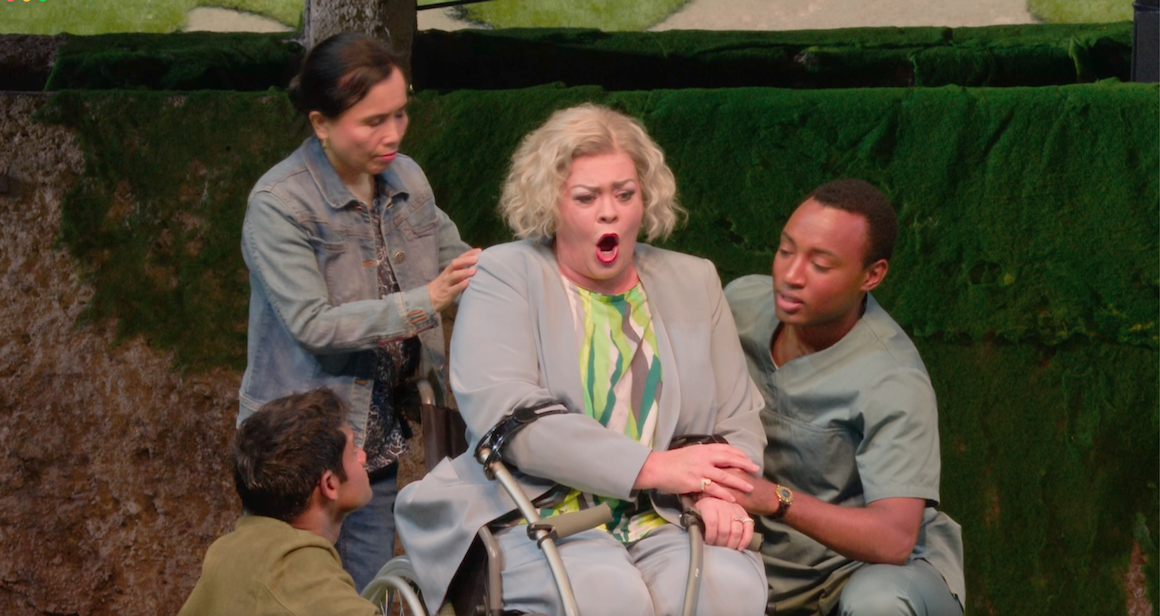
Polina, too, seems to be in debt to the Marquis with whom she is having some sort pf affair; possibly S/M based though the scene that suggests that is hard to see on the video. Alexey is besotted by Polina whose relationships and motivations are complex and obscure. She gives him money to gamble with which he loses. Then she tests his devotion with various crazy tasks like smearing a German baron with paint. We see Alexey starting to crack up mentally.

The rich grandmother (Violeta Urmana) arrives and to everyone’s shock and dismay gambles away her whole fortune and then leaves for Moscow. The Marquis calls in his debts. The General goes nuts. Blanche leaves him for a better sugar daddy bet The Marquis offers Polina money which she refuses. Alexey is obsessed with the idea of getting her back by paying off her debts but Polina scornfully interprets this as an attempt to buy her. It’s all quite manic and really hard to follow .on the video.

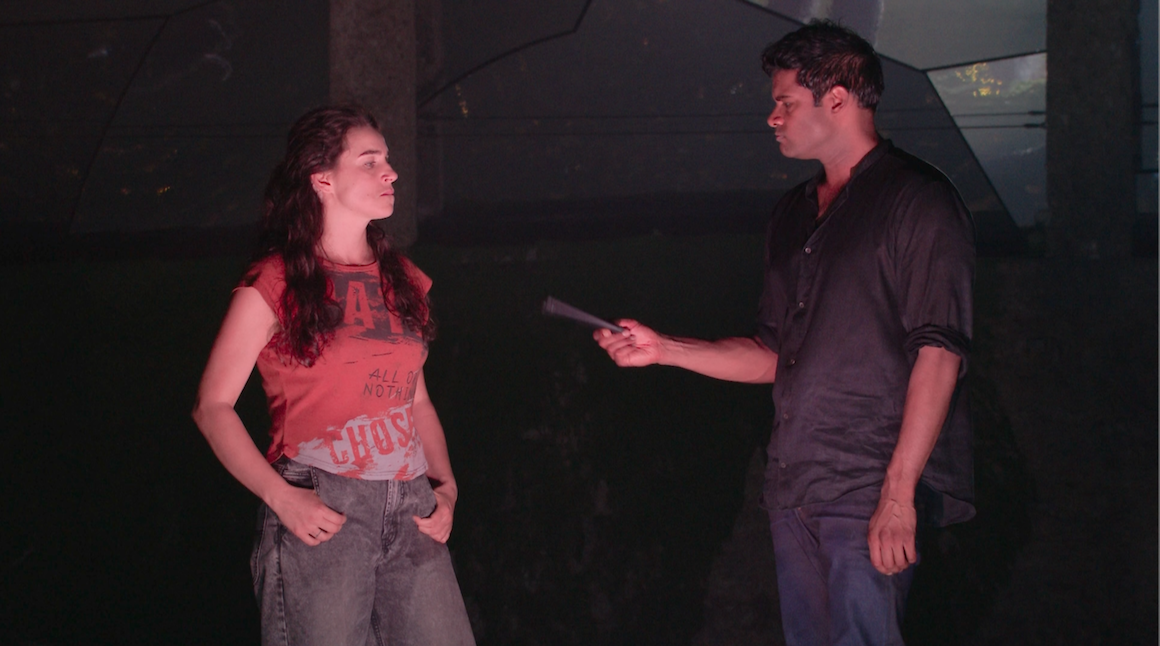
The final act has Alexey winning improbably often in the casino and breaking the bank at both tables. Red comes up twenty consecutive times; literally a one in a million probability. The crowd in the casino follows Alexey’s increasingly unhinged behaviour and also goes nuts. Polina is unmoved. Alexey offers her the 50k she need to pay off the Marquis. She takes it, then returns and throws it at him. Then she leaves. Curtain. No curtain calls.
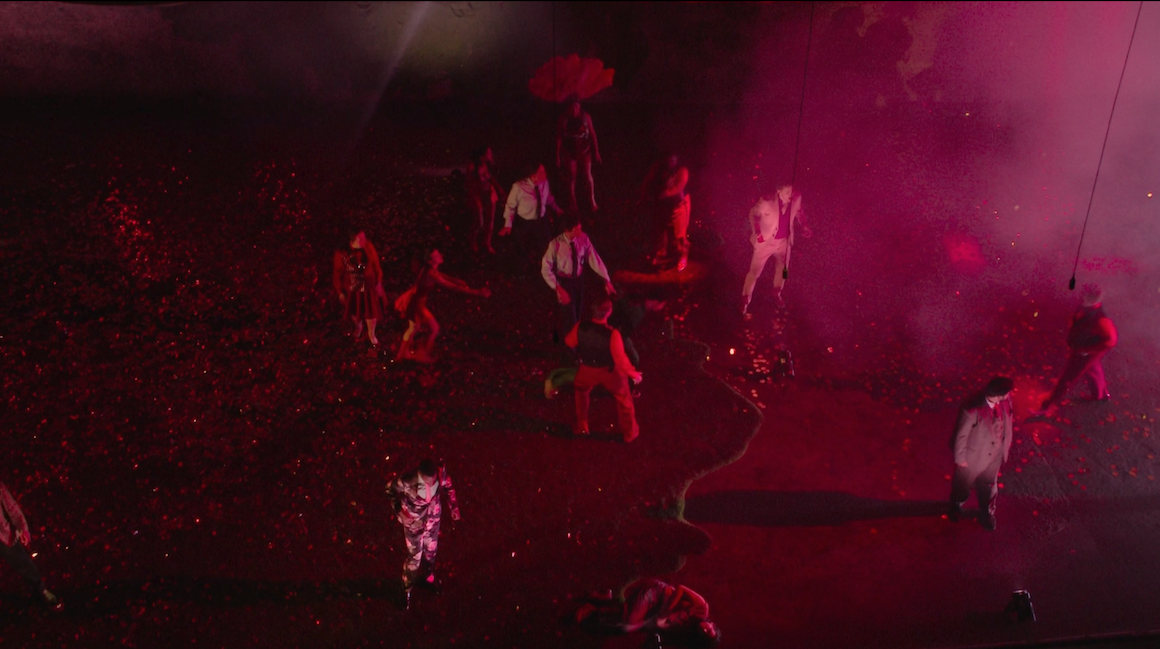
There are glimpses of much more going on around the back and sides of the Felsenreitschule but mostly all we get is the very central piece which is interesting enough. The various psychological arcs are very well portrayed. Panikkar is unnerving in one way and Grigorian in quite another. I don’t eally understand how one acts “enigmatic” but she does and, as always, it’s hard to gnore her when she’s on stage. Urmana is pretty funny as the old lady and both Chen and Gatelli are convincing. Vocally it’s all top drawer and even the minor roles (there are thirty one named parts) are done well. The chorus is excellent and Prokofiev’s spiky and colourful score gets an opulent performance from the Wiener Philharmoniker. Somehow conductor Timur Zangiev keeps everything co-ordinated.
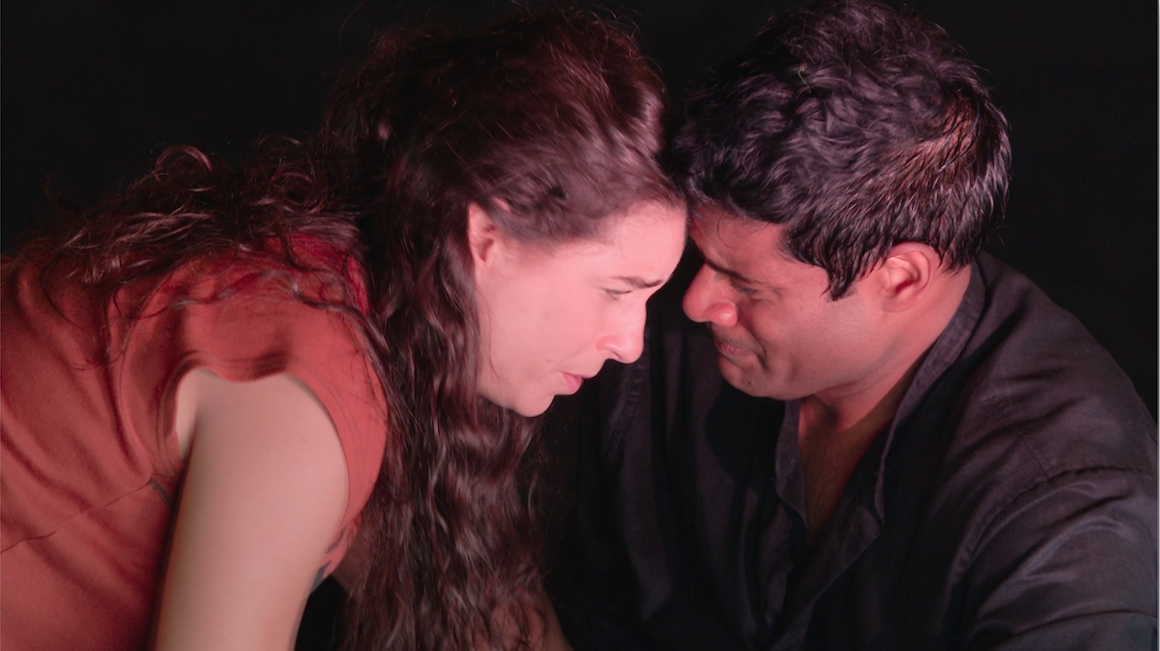
There are a few other Sellars eccentricities that deserve a mention. He’s very fond of shooting from directly over the top of the action as well as extreme close ups. There’s also the subtitles which use a weird mix of normal sentence case and BLOCK CAPITALS. (This was’t the case with the house surtitles). That said the technical quality is the usual Blu-ray package with DTS-HD-MA and 44kHz/28bit stereo soundtracks. It looks and sounds pretty good. Subtitle options are English, German, French, Korean and Japanese (no Russian). The booklet has a track listing and synopsis but the notes aren’t very helpful.

So it’s an interesting but frustrating disk with fine performances from Asmik Grigorian and Sean Panikkar. Sellars fans will likely want to see it but others may prefer the more straightforward Berlin production.
Catalogue information: Unitel Blu-ray 811704
 operaramblings