
“…it’s weirder and less funny and less charming than the plays I like to write, and also I’ve taken out a lot of the conventions, conventions that I like, the ones that make us want to watch plays.” So writes Hannah Moscovitch about her 2024 play Red Like Fruit which opened at Soulpepper on Thursday night as part of Luminato in a production directed by Christian Barry.
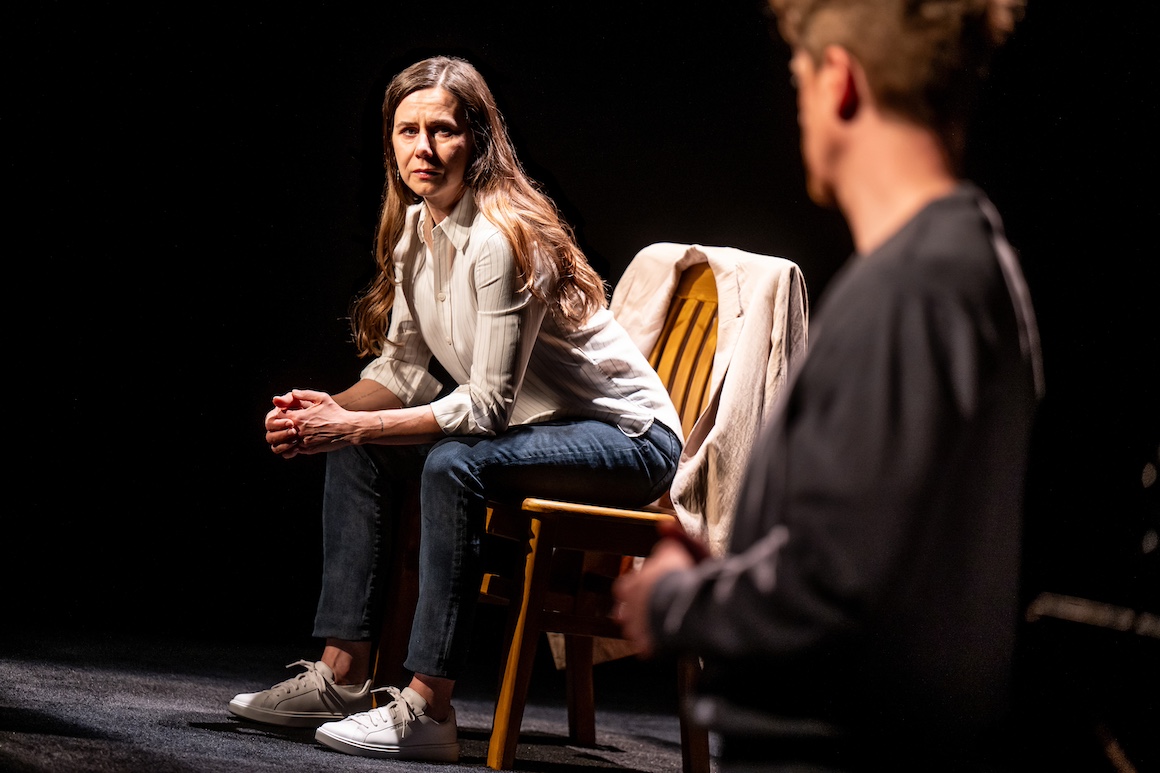
I quoted Moscovitch at length because she says it better than I could. Red Like Fruit is a very unusual, perhaps unique, piece of theatre. There are two actors. Michelle Monteith, as Lauren, sits on a chair on a raised platform for most of the play and says little. David Patrick Flemming, as Luke, stands by a lectern and delivers, basically, a 75 minute monologue punctuated with short exchanges with Lauren. Lauren is a journalist so she’s written her story but she wants it delivered by someone calmer, more authoritative, more male? In other words, Luke, about who we know and learn nothing.
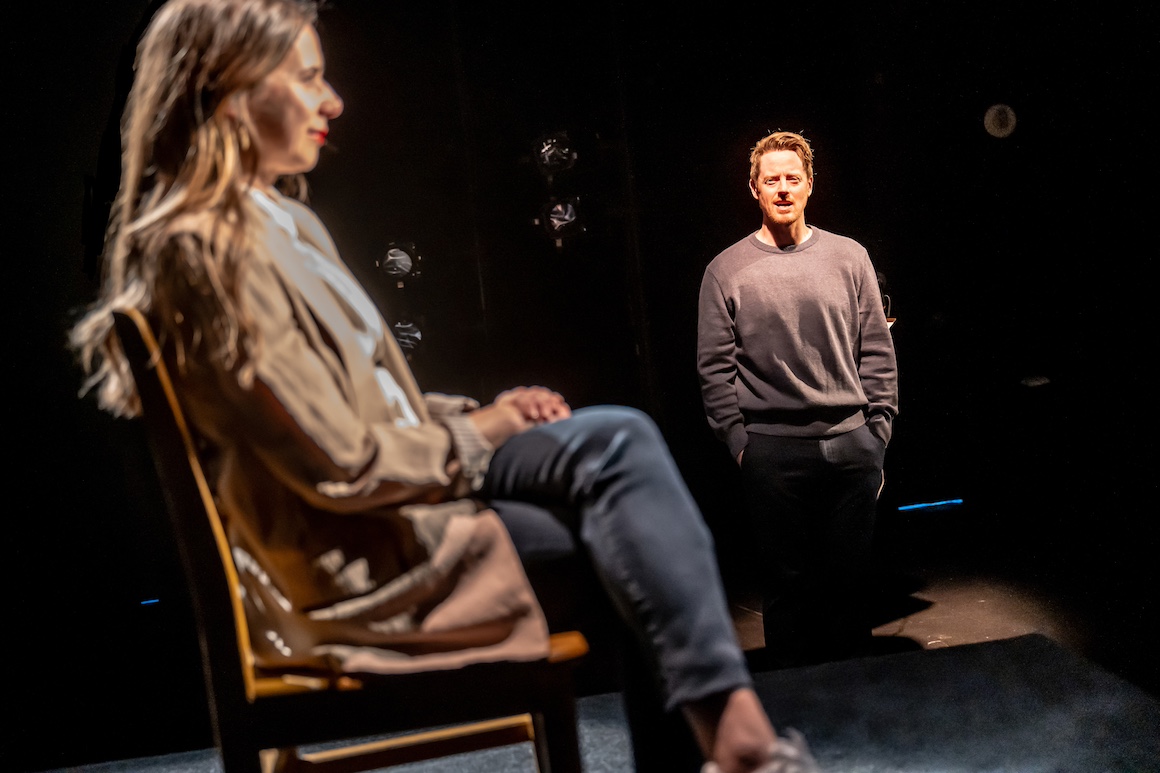
Lauren is a married woman with two children. She’s in group therapy of a sort and she’s researching a story about domestic violence by a Liberal Party operative, Andrew, who, despite having been convicted of a fairly serious assault on his girlfriend, Tiffany, is re-employed by the party. The details of researching and telling that story are horrific enough and graphically described but in the sort of dispassionate, “objective” language that “serious” journalists use to demonstrate their professionalism.

But Lauren starts to ask herself why did this happen? Why did this happen when and where and to whom it did? All this, despite the fact she’s seen it all before. She spins off into a series of stories of her own adolescent sexual encounters of a more or less consensual nature, starting by her being sexually assaulted by a much older cousin while still at high school. Drink and drugs are involved in every case and they are all a bit squalid. In different ways we have probably all been there which is, I suppose, the point. What role do they play in the life stories we tell others? That we tell ourselves? That we omit because including them would upset and offend? And if we all have such stories, what’s so special about Andrew and Tiffany?

The final few minutes of the play are Lauren and Luke wrestling, inconclusively, with questions of moral equivalence, contingency and inevitability and, almost inviting us, the audience, into the tent. Does anyone get closure? Of course not. Even if feasible that would be like the five painful rounds of surgery Tiffany undergoes to get the teeth knocked out by Andrew replaced.

I realise I’ve made it sound heavy and thinky and disturbing because it is. But it’s also very funny in an extremely dark way. The acting is sufficiently deadpan that we can listen to Lauren’s musings on why men think dick pics are attractive without gagging, which I think is more than she probably managed while being instructed in oral sex by her cousin. The timing is exquisite. Monteith’s facial gestures are priceless. It’s compelling… because of, or despite, the subject matter.

It’s one of the least conventional pieces I’ve seen on a Toronto stage (and I’ve seen plays with no actors and plays with no dialogue) but I found it moving and effective. Perhaps because it dares to do what mostly we don’t; honestly tell our own stories. Let’s let Moscovitch have the last word… “if pages and pages of my life are censored, then my life just becomes fucking incomprehensible doesn’t it – to you, to me.”
Red Like Fruit continues in the Michael Young Theatre until June 15th and you can get 20% off the ticket price by using code FRUIT20 at checkout.
Photo credits: Dahlia Katz except the third one which is by Riley Smith.
 operaramblings