
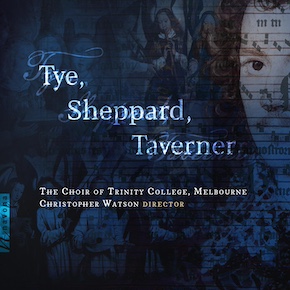
 The middle years of the 16th century was an interesting period for English church music. There was no shortage of musical talent or sponsorship but the political and ecclesiastical landscape was pretty mixed as the pieces chosen for a new CD from the Choir of Trinity College, Melbourne reveal.
The first piece is a setting of the Lord’s Prayer in English by John Sheppard; Informator Choristarum at Magdalen College. It’s fairly straightforward polyphony but the text is interesting. It’s in English so it must post date Henry VIII, during whose reign the Mass was still sung in Latin, but the wording is slightly different to that of the first edition of The Book of Common Prayer of 1549 in that, among other minor variations, it concludes with “So be it” rather than “Amen” so we can probably date it to the first two years of Edward’s reign.
Next is a five voice motet by John Taverner; Christe jesu, pastor bone. This is known to date from the period when Taverner was organist and choirmaster at what was then Cardinal College (later Christ Church); a position he left after Wolsey’s arrest in 1529. The version sung here includes the later amendation of the text to make the second verse a prayer for the preservartion of Queen Elizabeth.
The most substantial piece on the record is the Missa Euge Bone of Christopher Tye who set the Credo, Sanctus, Benedictus and Agnus Dei for six voices. Tye was a Cambridge man and this work was written either for the new chapel at King’s (opened 1536) or for the refounded Ely Cathedral where Tye became choirmaster in 1542. It may have been part of his successful submission for a doctorate in 1545. It’s rather beautiful with a particularly elaborate Agnus Dei.
John Sheppard’s Jesu salvator saeculi redemptis is also rather interesting. It’s a setting of a ninth century hymn in the “Alternatum” style. The odd numbered verses are sung as plainchant; given here to the basses, while the even numbered verses are given a polyphonic treatment. Apparently this was quite common at the time and it’s certainly an interesting effect.
The last piece is John Taverner’s Mater Christi sanctissima which is an antiphon for the Virgin Mary. It almost certainly dates to the 1520s when he was at Cardinal College. It’s another five voice motet using a style better known in continental Europe.
Trinity College is the Anglican residential component of Melbourne University which I guess gives it a role similar to St. John’s or St. Chad’s at Durham; part university college/residence, part Anglican theological college. The choir contains male and female voices and it’s very good. It’s director Christopher Watson, clearly knows his way around Renaissance polyphony.
The recording was made in Trinity College Chapel in November 2024 and it has the acoustic one would expect; at least in the high resolution (96kHz/24bit) version I listened to. It’s a digital only release with a range of resolutions p[lus MP3 available as well as beingavailable on a range of streaming services. As usual with Navona releases there’s no booklet but there is a dedicated web page with notes, texts, credits etc.
All in all, this is a very well performed and recorded record of music that really does illustrate what was going musically in a particularly tumultuous time in English church history.
Catalogue information: Navona Records NV6731
 operaramblings