
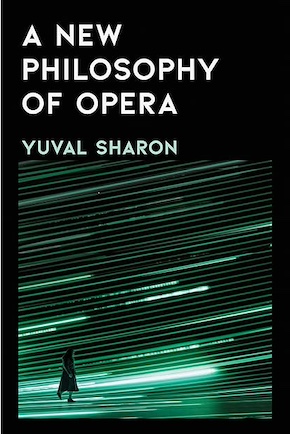
 A New Philosophy of Opera is a recent book by opera and theatre director Yuval Sharon. It deals with that thorny question “How do we revitalise opera?”. It contains a lengthy critique of the current opera world; repertory, performance practice, business model, and some pretty radical suggestions for ways forward. It’s focussed on the US but I think it’s pretty relevant to Canada too. It’s also worth pointing out upfront that Sharon’s way forward is not at all based on the German model. He’s actually quite critical of it as being almost as ritualistic, lifeless and elitist as the US model.
So let’s look at his critique of current practice. It can be summed up by the three adjectives in the previous sentence. So, inter alia:
- The over reliance on a small number of operas, mostly from the long 19th century, in essentially traditional productions presented using rigidly prescribed performance techniques stifles creativity and makes real audience engagement impossible. The performers are “lobotomized by routine”.. “”which implicates the audience in an embalming ritual”.
- This is supported by a risk averse business model dominated by a handful of wealthy, conservative donors. “The prevailing mandate of most opera companies is to pacify the tradition bound” and “We are giving [the audience] what [it] wants” actually parses as “We are giving [the entire population of the city] what a [tiny minority of wealthy individuals] knows and is comfortable with”.
- The traditional opera house and its “audience practices” are designed (or perhaps have evolved) to exclude the outsider or newcomer.The current trend to update opera by “borrowing” successful narratives from other media; What I have often referred to as the opera of the film of the book phenomenon, is a dead end. Opera is fundamentally not narrative driven. There is no point in “giving the audience what they wanted at the movie theatre but slower, longer, more expensive and less entertaining”.
And, in case you wanted to know, his argument against the German model is that it demands a “consistent concept” which works against ambiguity as much as the strait jacket of the “composer’s original intention” whereas Sharon argues that ambiguity is at the heart of great art. Parenthetically he mentions research that links a lack of tolerance for ambiguity to a taste for totalitarianism…
Turning to his ideas on how to move forward I want to make it clear that he is not being prescriptive, rather he’s arguing for experiment and a radical opening up of the creative process and I’m probably, in summarising, going to make his positions sound more didactic than they are. It seems to me that his ideas fall into two complementary buckets.
First is a set of ideas concerned with revitalising what is performed in the opera house.
- “Discovering the best way to invite an audience away from the urge to decipher – away from the dominance of narrative – and toward the symbolic should be the primary mission of all opera-makers”.
- All works of art exist in a dialogue with past, present and future and this is especially true of a live performance which is essentially ephemeral. So, what has come before; the printed libretto and score, previous performance practice etc, can only be seen as guides to what is being created this time. That needs to be the result of deep collaboration between everyone involved in the process including the cast. “Rehearsals are not the place to simply enact what you’ve already discovered but rather the place to undergo a discovery process”.
- The three “tracks” of music, text and production exist in an unstable relationship with none predominating and all of them subject to change if necessary. We need to go back to the mindset of Monteverdi’s era when the score was a guidebook not an instruction manual. The most famous Sharon example of this is probably the La Bohème he staged in Detroit that reversed the order of the scenes.
- We should embrace technology. It’s a bit nuts that we embrace everything technological to do with production such as electric light, projections and so on but fulminate against the very idea of sound conditioning. If it makes the performance better, why not?
- And perhaps more importantly he envisages a change in the relationship between producers and audience in which the audience is less passive. “I want a production to constantly unsettles an audience and ask for continuous renegotiation of their experience”.
But his most radical ideas don’t involve that gilt and plush palace at all. He regards it as essentially alienating and is a strong believer in staging opera in non-traditional spaces. He cites examples such as his version of Götterdämmerung staged as a drive though in the theatre’s parking garage, a performance using headsets for the audience in LA’s central station and Hopscotch in which audiences members and performers were driven around central LA with the performance from each car being screened at a central hub.
And if that sounds crazy then Sharon’s answer would be “Opera would do better to cultivate more foolishness, more anarchy, more unruliness”.
Obviously a review/summary like this doesn’t do justice to a very rich set of ideas but I hope I’ve piqued your curiosity. For my part I found a lot to agree with. I don’t go to the opera for bland entertainment or to have my intellectual or social status validated. I go because I love art and the insight it can give into the human condition. I want to be challenged and I don’t mind being made uncomfortable so, unsurprisingly, I find myself in broad agreement with Sharon on most of his analysis and suggestions. I am however pessimistic about one thing and sceptical about another.
I don’t believe that the business model of opera is going to change in north America. Opera is no different from most other businesses. It’s intrinsically terrified of innovation and nobody is more terrified than people who got to leadership positions by playing the existing game well. Turkeys don’t vote for Christmas. Parenthetically that’s why I have been having a good laugh at all the articles in Opera Canada this last couple of years about how business executives look to “The Arts” for help with innovation and creativity. I think in my entire career in business and government I met three CEOs who actually believed in innovation (in anything other than product)! So I think we are stuck with phoned in, cardboard Carmens for the foreseeable.
I’m also quite sceptical about “site specific” productions. I’ve been to a fair few of these and the problems seem greater than the value, if there is any. Unless the audience is very small they present huge problems of acoustics, sight-lines and logistics (including the inability to accommodate those with mobility issues) which, if nothing else soak up the creative energies of the production team to the exclusion of the actual work. And if the audience is very small then haven’t we just created a new kind of elitism/exclusivity? I have enjoyed such productions; for example Tapestry’s Bandits in the Valley but I’ve never had a “revelatory” experience at one.
There’s much, much more in Sharon’s book than I could touch on here. It’s well worth a read for anyone who thinks that opera needs a kick in the pants.
And if you want a taste of Sharon’s work his 2018 Bayreuth Lohengrin is available on DVD. It may not be the best example though as I have heard that he was constrained by design choices made before he joined the project
 operaramblings
Wonderful summary, John; curiosity definitely piqued!
Thanks!