
I have long been of the opinion that Beethoven’s Fidelio is structurally flawed. The first and second acts are so different intone and dramatic intensity that it never seems quite to hang together. Tobias Kratzer obviously shares this view but being smarter than me finds a way to leverage it. For his production at the Royal Opera House in 2020 he takes the two acts and effectively makes the second a commentary on the first. It’s worth quoting his own words:
Like no other opera, Beethoven’s Fidelio falls into two unequal halves. Act I is a historical melodrama on freedom and love in the post-Revolutionary era. Act II is a political essay on the responsibility of the individual in the face of the silent majority, a musical plea for active empathy.
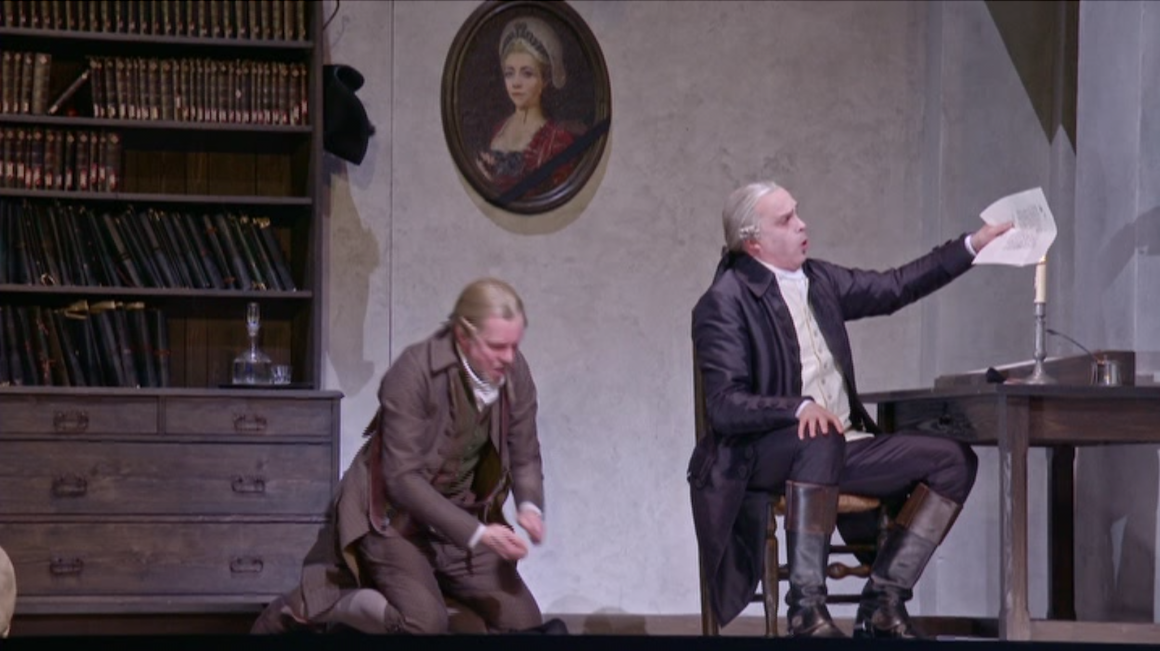
 And that’s how he stages it with some changes, mostly additions, to dialogue and some addiitional speaking characters. So, in Act I we are in post-Revolutionary France. There’s a bit of additional business around the Leonore, Marzelline, Jacquino love triangle and there’s quite a complex take on Don Pisarro. He clearly believes that any repressive acts he may be responsible for are necessary to defend the revolution which is a clearer and more convincing motivation than the libretto as written. In this version it’s also clear that Marzelline has rumbled Leonore well before the end of the act which will become important later. All that aside it’s a fairly lavish, carefully drected period costume drama. Also, Leonore is frisked before she enters the dungeon and her pistol is taken away.
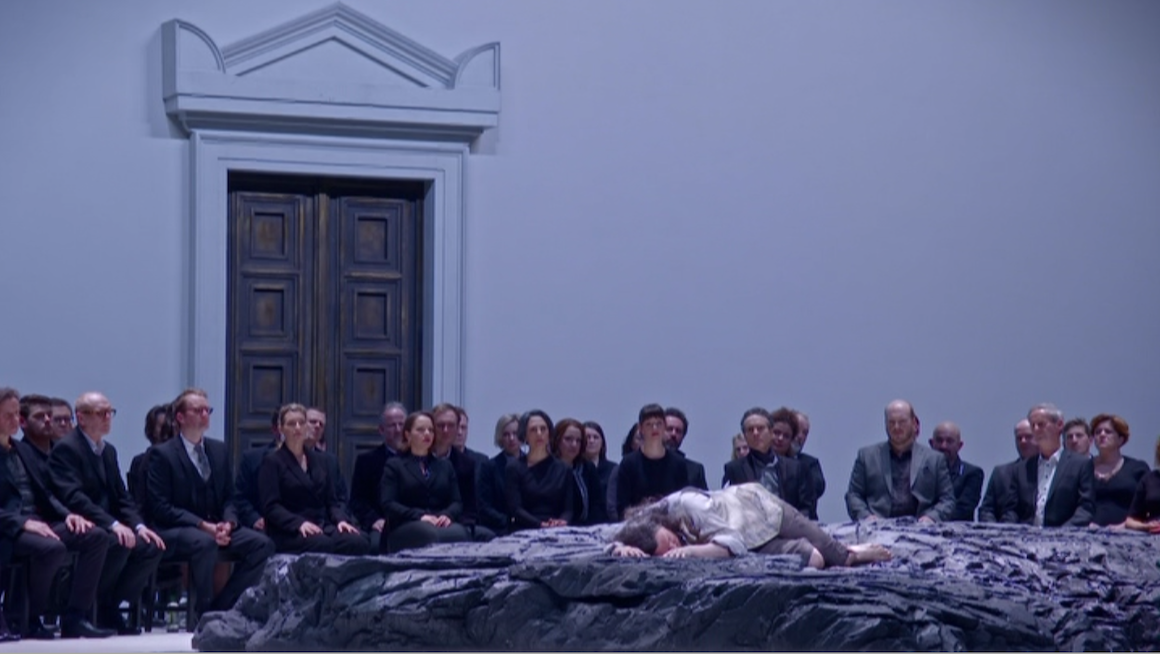
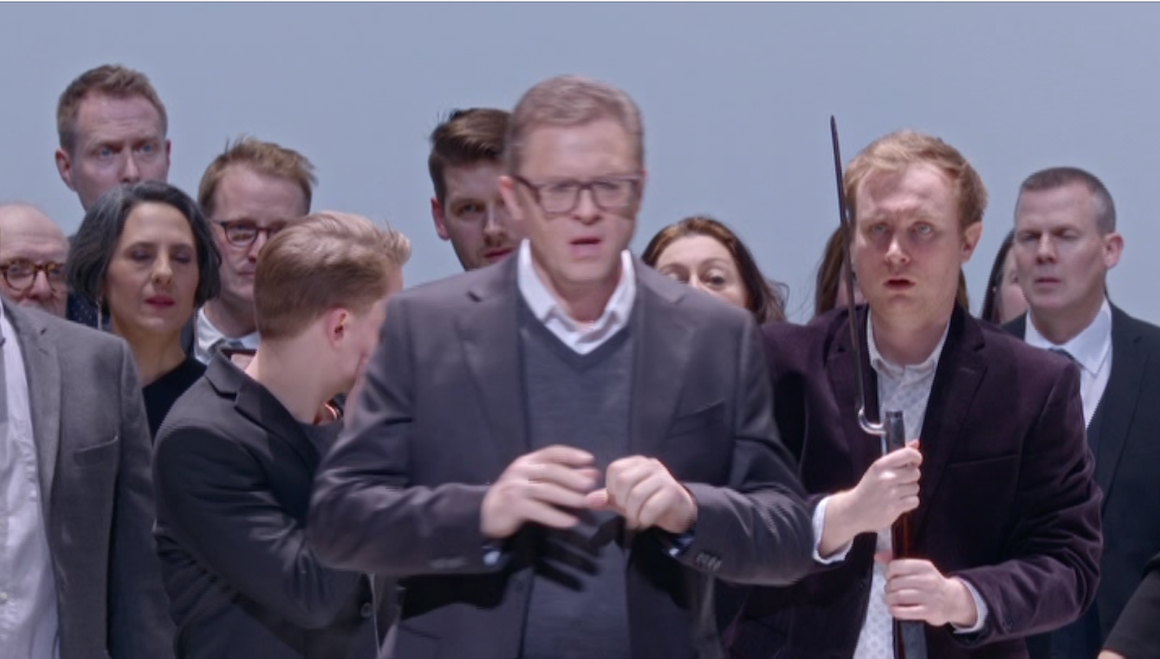
Act II shifts gears on us. We see Florestan chained to a rock in front of a circle od onlookers (the chorus) in modern dress. The faces of some of the “audience” are projected in giant size behind the live action and we can see in detail the reactions of some of them as the action unfolds. Filorestan, of course, is oblivious to the audience but when he sings “Gott! Welch Dunkel hier” it’s quite ambiguous as to whether he’s talking about physical or metaphorical darkness.
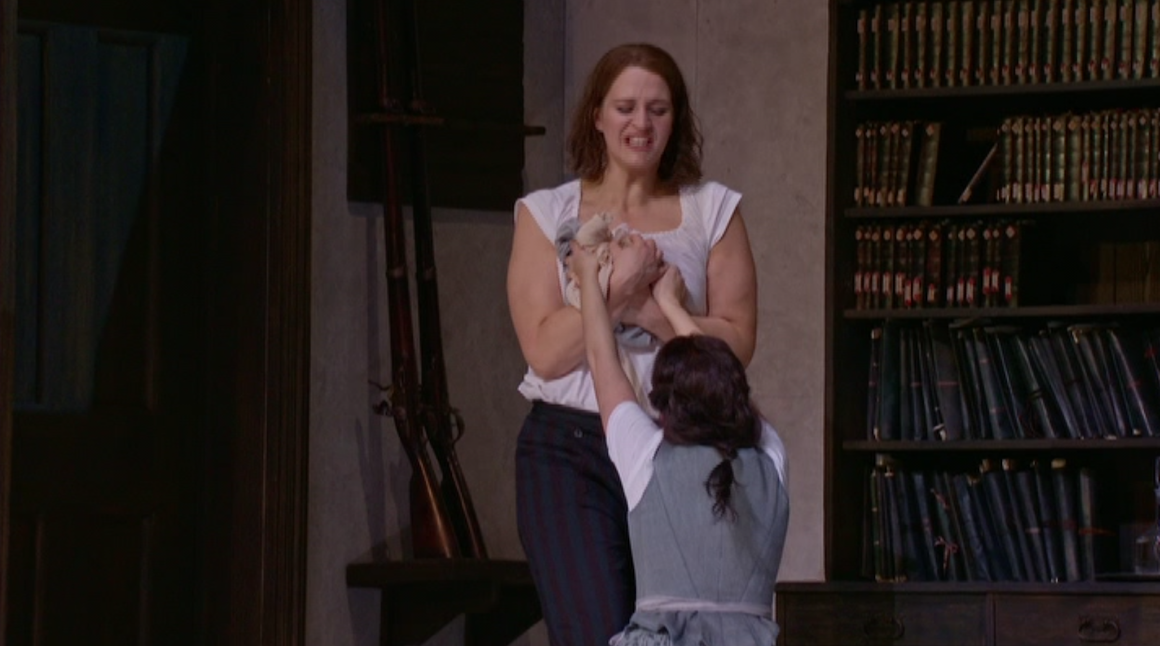
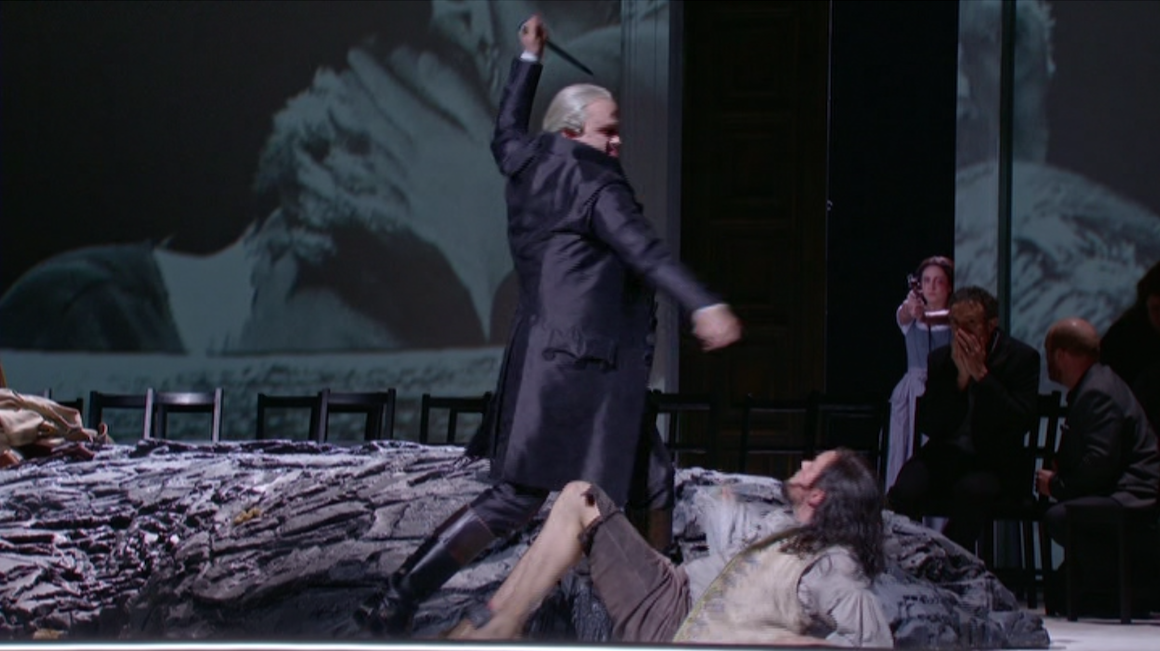
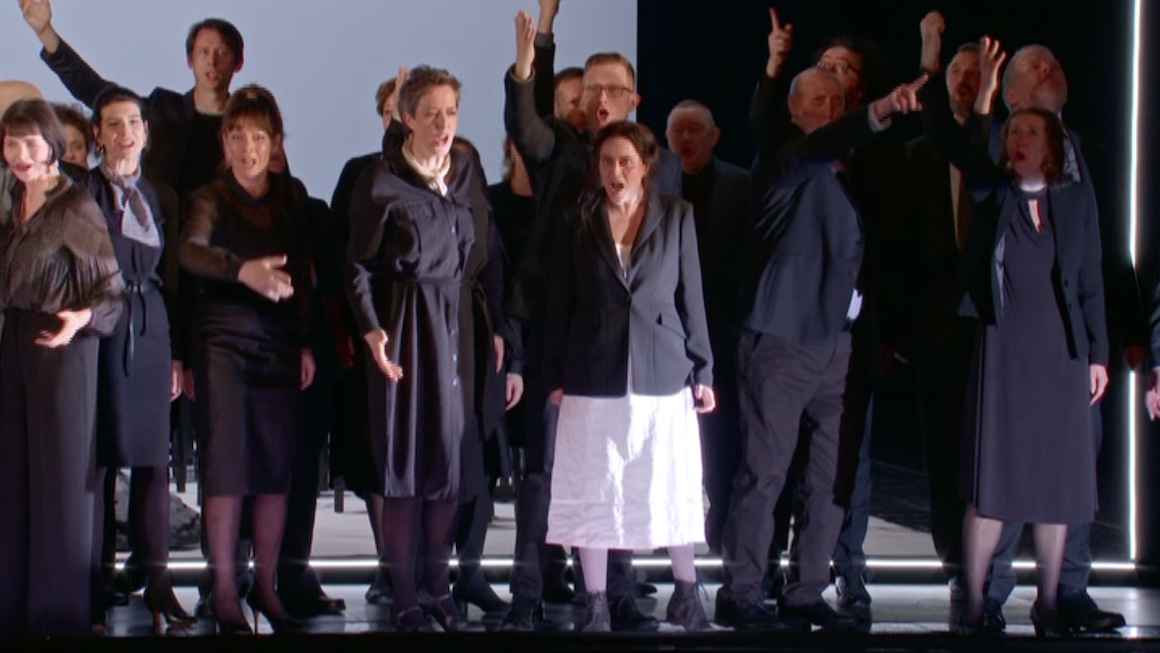
Leonore and Rocco enter and do their thing and then Don Pisarro appears prepares to kill Florestan. Pistol-less Leonore is powerless to prevent this but when the trumpet call announcing the minister’s arrival is heard it’s Marzelline who enters; bugle slung on her shoulder and pistol in hand. She shoots and wounds Don Pisarro. (at some point the projections disappear but it’s not clear exactly when on the video). Don Pisarro’s soldiers enter threateningly but the “crowd” comes to life and disarms them. Don Fernando, in modern dress, emerges from the crowd and makes his plea for justice. During the final triumphal chorus, the crowd moves to the front of the satge and gestures to the audience as if to say “you too”. The message is clear; “we” can overcome tyranny but only if “we” act and “we” includes all of us. I found it extraordinarily effective and, for the first time for me, Fidelio really made sense.
This performance is also extremely well sung and acted. At the heart of it is a terrific performance by Lise Davidsen as Leonore. This is a terrific role for her. She has the vocal chops and, unlike most Leonores, looks the part. She’s also a more than capable actor. Marzelline has much more to do in this show than be a lovelorn teenager and Amanda Forsythe is terrific. She sings very well and projects a kind of deep kindness mixed with empathy that is quite beguiling. Simon Neal is excellent as Don Pisarro. This production demands he be much more than a moustache twirling villain and he does convey the necessary complexity. David Butt Philip’s Florestan is ardently sung and captures the mood of the second act rather well. Georg Zeppenfeld is sympathetic Rocco; played as a man with a conscience but a job to keep rather than a bumbling idiot. Egils Siliņš is suitably professorial in his brief cameo as Don Fernando. That leaves Robin Tritschler’s Jacquino. I’m not sure what to make of it. He sings very nicely but I’m not sure what Kratzer is doing with the character so it’s hard to gauge the performance.

Fidelio is notoriously difficult to sing. Sometimes it’s just put down to beethoven being a bit rubbish at writing for the voice (which has an element of truth to it). Here conductor Antonio Pappano decides to flow with the idea that it’s basically a symphony with voices among the instruments and has clearly gone to great lengths to get the sound he wants from soloists and chorus. The end result is satisfying.
Rhodri Huw directed the video and it’s decent. There’s a lot going on and sometimes there is action either on both sides of the stage or on the stage and projected behind it and it’s just not possible to fully capture the “in-house” experience but it’s fairly close I think. I watched this on DVD (Blu-ray is available) and the audio and video quality is pretty decent. The sound tracks are DTS 5.1 and, weirdly, Dolby stereo. The DTS is OK on speakers or ‘phones. Subtitle options are English, French, German, Japanese and Korean. There’s about five minutes of extra material on the disk which is a must watch prior to the main feature and goes a long way to making up for rather cursory documentation.
All in all, this is much the most satisfactory Fidelio production I have seen and it’s backed up by excellent performances.
Catalogue information: Opus Arte DVD OA1334D
 operaramblings