
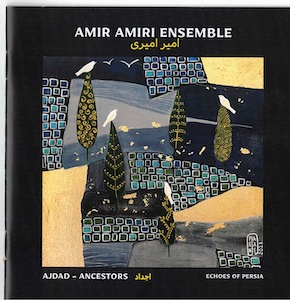
 Ajdad – Ancestors (Echoes of Persia) is a new CD from the Amir Amiri Ensemble. I had a chance to hear them play at Alliance Française on Friday night as well as listening to the CD which provided some extra perspective. It’s always interesting to watch musicians. Most of the music on the CD is composed by Amir Amiri with a couple of arrangements of other composers’ work. Amiri’s roots are in the classical Persian tradition but he goes well beyond that with quite strong Arabic influence as well as Turkish, Kurdish and Western classical elements. In a sense it’s a nod to what was once a more integrated musical culture that to some extent has been fractured by the political divisions of the last 100 years or so.
At the core of Amiri’s music is the instrument he plays. It’s a santur but a most unusual one. The santur is a 92 string hammered dulcimer and traditionally it’s tuned to a single key. However, Amiri plays one invented by Mohsen Behrad of Vancouver which has moveable bridges allowing for much greater tonal flexibility. The rest of the ensemble is made up of Reza Abaee on Ghychack (a bowed instrument like a miniature cello but with a very melancholic sound), Omar Abu Afach on viola, Abdul-Wahab Kayyali on oudh (one of the lute family) and Hamin Honari on various percussion instruments.
So it’s an ensemble that can create multiple sound worlds. In some pieces the influence of the Persian Radif system (a bit like the raga system used in Hindustani tradition) is very clear. Good examples include “Chahar Pareh” (Four Fragments) and the haunting ghaychack solo “Sarzamineh Madara” (Towards my Motherland). In a different vein “Sarzamin” (Spirit of Our Land) is an oudh solo that traverses the varied melodic and modal language of the Arabic tradition. Other pieces combine cultural elements to evoke natural phenomena such as sun and rain. The album concludes fittingly with “Ajdad” (Ancestors) which riffs off funeral processions to suggest that we celebrate life with music and dance rather than mourn it with tears. The middle east could use more music and dance and fewer tears right now.
In summary, this album contains 45 minutes of varied and rather beautiful music which brings together a range of musical traditions and adds Amir Amiri’s distinct voice. It’s nicely recorded and available as a physical CD which comes with excellent documentation (though how one acquires a copy short of attending an Amir Amiri Ensemble concert I don’t know). It is also available digitally though on streaming services and from itunes.
 operaramblings