
Cherubini’s Medea, in the 1909 Italian version being used by the COC, got there by a fairly circuitous route. Euripides 5th century BCE tragedy and Seneca’s 1st century CE play inspired a French verse version of 1635 by Thomas Corneille which was turned into an opera by Marc-Antoine Charpentier in 1693. In 1797 a version with music by Cherubini to a libretto by François-Benoît Hoffman; retaining much of Corneille’s version as spoken dialogue, premiered in Paris. In 1909, for the Italian premiere at La Scala an Italian translation with added recitatives was used and that became, more or less, the standard version for its rare 20th century revivals (most notably in the 1950s with Maria Callas) and that’s the version being given at the COC with Sondra Radvanovsky in the title role. Understandable really. It’s hard enough to find a cast that can do justice to the music. To expect them also to be expert at declaiming Alexandrines en français is probably expecting a bit too much.

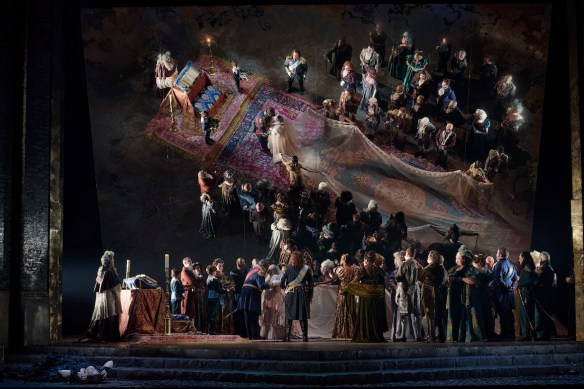
This production of Medea was designed by Sir David McVicar and originally directed by him at the Met. It’s spectacular, beautiful and very, very McVicar. The main set feature is a full width of the stage angled mirror. Viewed from the orchestra seats where we were this means one has two views; front on and from above, which is used to great effect. (How well this worked for folks in Ring 5 I can’t say). So in scenes like Glauce’s wedding procession we see her and her attendants from above quite a few bars before they are directly visible. There’s a bonus too. The mirror reflects sound as well as light so there are no acoustically dead spots which have been something of a problem with some other recent COC productions.

Supporting all this is lots of gold leaf, dramatic projections and sound effects and very good direction; especially of the chorus. How much of this was down to McVicar and how much to revival director Jonathon Loy I can’t say but it worked. And, it being McVicar, the Argonauts are a troupe of actors and acrobats who cavort energetically with fist fights, somersaults and what not. Throw in colourful, if weirdly eclectic, costumes and some great lighting and “spectacular” seems a bit of an understatement.
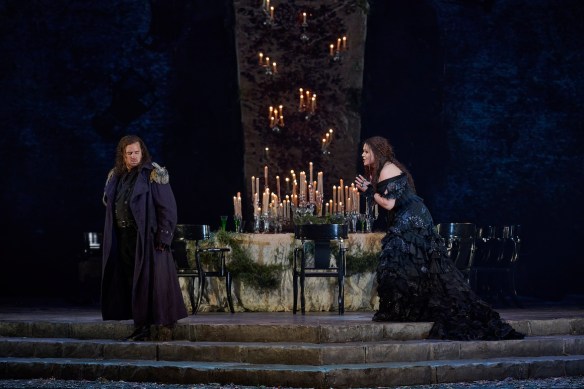
That’s really just the beginning. The cast is the strongest of any post-pandemic COC show and harks back to some of the more spectacular pre-plague ones. Given current economics we may not see their like again any time soon. Front and centre is Radvanovsky’s Medea which is Callas-like in intensity. Her acting is bold and by turns sympathetic and menacing. Her singing is a wonder. She has power to burn but floats her characteristic high notes quite beautifully. She can also produce something closer to a growl or a snarl without losing musicality.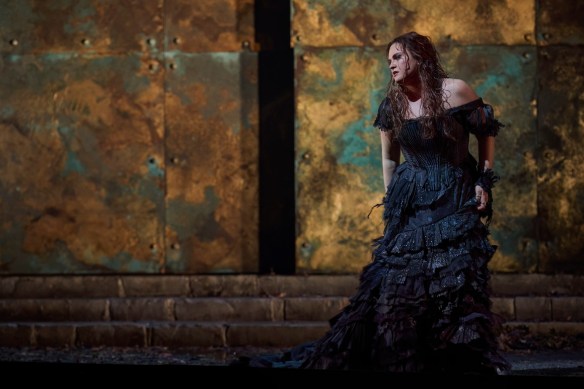
She’s very well matched by Matthew Polenzani’s heroic tenor. It’s hard to sympathise with the ambitious and ruthless Giasone but at least he can sound like someone who could steal the Golden Fleece. Janai Brugger was a sweet toned and sympathetic Glauce and Alfred Walker, was absolutely rock solid as Creonte. Both were making their COC debuts. The discovery of the evening was young American mezzo Zoie Reams as Neris. Also making her COC debut, she has a powerful but beautiful and smooth voice that impressed in all the registers. Recent and current Ensemble Studio members Alex Hetherington, Charlotte Siegel and Alex Halliday rounded out the cast and all got the job done. The COC Chorus was exceptional even by its own high standards.

One thing I have learned about these late 18th and 19th century French works is that they are not Puccini and, regrettably, the Italian versions of them often seem to get conducted as if they were (perhaps more a problem fifty years ago than now). Lorenzo Passerini doesn’t make that mistake. He moves things along at a brisk pace with supple shaping of the phrases that recalls French performance practice. The orchestra responds admirably. It never drags.
All in all, what happened last night was more than the sum of its parts. Everything came together to make for a rip roaring and highly musical spectacle. It’s grand opera at its grandest and not to be missed. But hurry. There are only five more performances. Radvanovsky will sing the next three then it’s over to Chiara Isotton. From what I’m hearing from insiders she too will be spectacular.

Cherubini’s Medea continues at the Four Seasons Centre until May 17th.

Photo credit: Michael Cooper. The photos were taken at the Final Dress when Chiara Isotton sang the role of Medea.
 operaramblings
This is a great production of a great opera! The performance of the cast and chorus was excellent, but most outstanding was the performance of Chiara Isotton, as Medea!!
The staging, lighting, and sets were spectacular. The standing ovation was sustained to honour the performance. I was happy to be among those who witnessed such a fine production and the debut performance of Ms Isotton.
Thank you, M. Hutzul
So did Chiara sing on Sunday? Sondra was scheduled. Curious!