
“Thou shalt not take lightly the great name of Death”. So, sung to a weird version of the tune of Ein Feste Burg, ends the closing chorale of Viktor Ullmann’s Der Kaiser von Atlantis. To the best of my knowledge there has never been a commercial video release of this work but it was filmed as a BBC/WDR co-production in 1977 and broadcast in both Britain and Germany. I just got my hands on a copy of the BBC broadcast and thought it was well worth writing about.
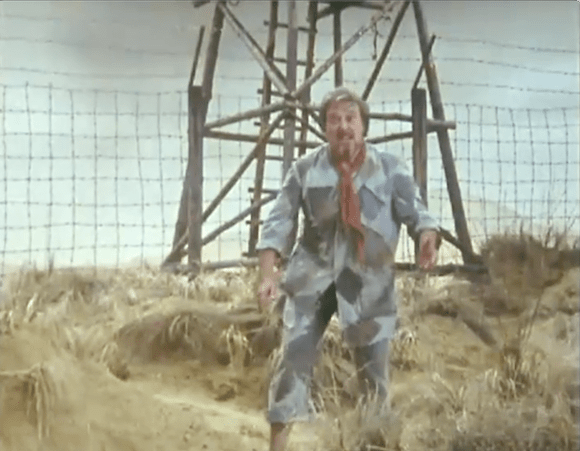
It’s a peculiar work in many ways. Librettist Peter Kien and Ullmann created it in 1943 in Theresienstadt; a year before they went to their deaths at Auschwitz. By something of a miracle the music and libretto (written on the backs of Gestapo forms) were preserved by Doctor HG Adler who was also an inmate and who survived both Theresienstadt and Auschwitz, It’s an allegory in an expressionist sort of style of a kind not unfamiliar in German theatre of the period. Kaiser Überall rules his empire from a bunker communicating with the outside world solely by telephone and loudspeaker. To consolidate his power he decrees the war of “all against all” but he doesn’t count on Death who, disgusted by the usurpation of his power by the modern totalitarian state, basically goes on strike. Nobody can die but everyone still suffers. The population revolts. Death agrees to resume work but only if Ũberall becomes his first victim. He consents. Normal service is resumed.
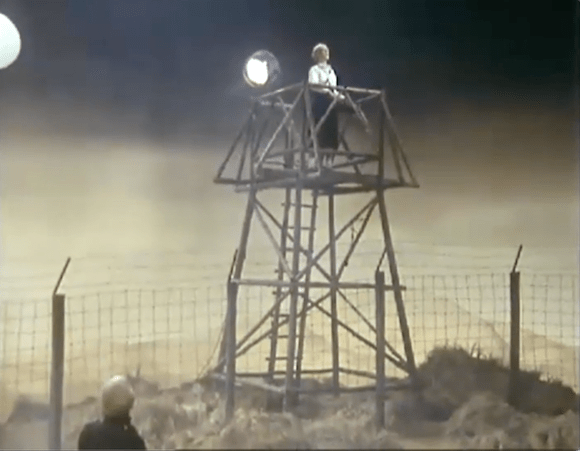
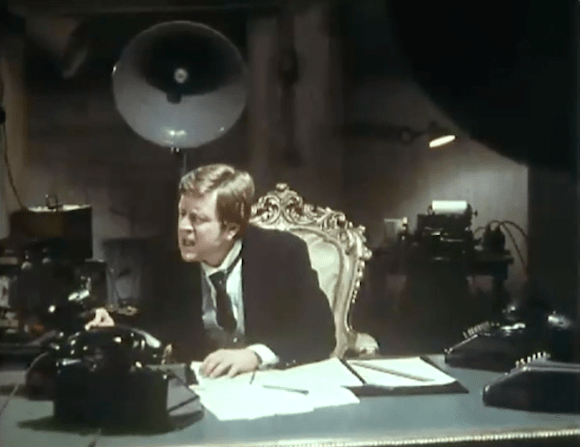
There are four four scenes. In the first, set here either on a border or in a camp (there’s barbed wire and a guard tower), Pierrot, who can no longer make people laugh, and Death discuss the horror and futility of modern life. When the Drummer Girl proclaims Überall’s new war, Death declares that his old legs can’t keep up with modern mechanized war and resigns by breaking his sword. In scene 2 we see the Kaiser in his bunker/office taking in reports that nobody is dying. There’s a sort of black humour here as he keeps calling the hangman to check on the progress of executions and is continuously reassured that the prisoners will die in a few more minutes.

In scene three a Soldier and a Girl encounter each other in No Man’s Land. When they realise they can’t kill each other they fall in love and refuse to rejoin the war at the Drummer Girl’s insistence. Instead they sing a love song. So to the final scene where Überall is trying to stem the collapse of his empire. He’s serenaded by Pierrot and the Drummer Girl to no avail. When he pulls the drapes off the mirror in his office he sees Death. They dialogue but finally the Kaiser agrees to die. Death leads him off through the mirror while the other four characters sing the final hymn.
Musically it’s pretty interesting. There are echoes of both cabaret and film music. The influence of, among others, Schoenberg and Weill is obvious. It uses several tunes that would have been recognisable to contemporaries and it’s unusually scored. It uses a chamber ensemble including banjo and saxophone for instance. There’s also quite a bit of spoken dialogue so it has the air more of a Singspiel than a full blown opera.
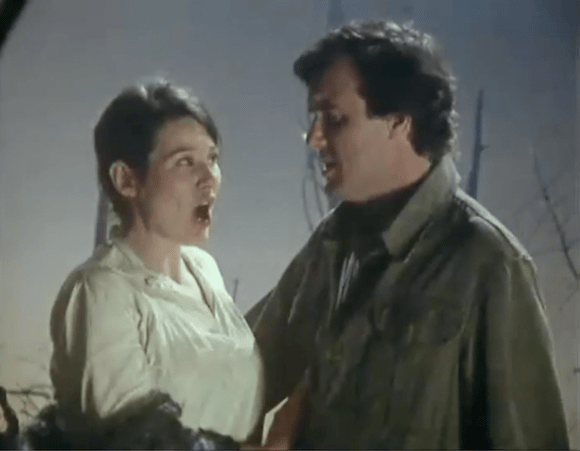
The performances are excellent. Bass Alexander Malta, as death, is suitably sepulchral and baritone Siegmund Nimsgern is very convincing as the deadly but slightly mad Kaiser (no prizes for guessing who the character is based on). Tenor Richard Lewis is a really interesting Pierrot. He’s quite stylized,in the manner of the production generally, but also very human. He sings rather beautifully too. The Drummer Girl is Teresa Stratas. She looks and sounds impressively young. The cast is rounded out by Janet Perry, as the Girl, and Rüdiger Wohlers, as the Soldier. The orchestra is the London Sinfonietta with Kerry Woodward conducting. I think the orchestral music was recorded in London and then integrated into the filming in Germany.

Director John Goldschmidt and his creative team opt for semi-abstract, impressionist sets and a somewhat stylized acting style which works well. The video is 1977 vintage 4:3 aspect ratio made-for-TV and the sound is mono but both are surprisingly decent. The BBC broadcast came with an introduction by a very 1970s BBC chap who also interviewed Goldschmidt. There’s also an interesting presentation by Dr. Adler of how he was able to preserve the work along with a description of life in Theresienstadt illustrated by drawings by Peter Kien. In short, it’s good old fashioned BBC Arts television!

Now the problem bit. I spotted this by chance on a torrent site devoted to free-to-air British (mostly) TV. It was buried away under a series labelled Masters of Horror; which was a 2005 TV series, but no source I can find lists this as one of the episodes. In fact I can find no reference to it having been rebroadcast after the initial showing in 1977. It’s too early to have been recorded on VHS and anyway the quality is too good. So, I have no idea where the poster got it from. If I find out more I’ll update.
 operaramblings
In 2004 we had an excellent production of Der Kaiser von Atlantis in the Bockenheimer Depot here in Frankfurt, conducted by Johannes Debus and directed by Andrea Schwalbach.
https://operasandcycling.com/operas-in-the-bockenheimer-depot/
I’ll ask Johannes about that when I next see him!
There will be a talk about the reception history of Der Kaiser von Atlantis on Monday, Jan. 22 at 4 pm at the Jackman Humanities Institute (U of T) by Amy Wlodarski, who is writing a book on that subject. Details here: https://www.jewishstudies.utoronto.ca/events/amy-wlodarksi-musical-historiographies-spiritual-resistance-international-reception-viktor
Thanks for that!