
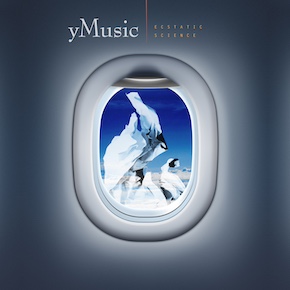
 Ecstatic Science is the fourth album from New York sextet yMusic. They are a young group of really excellent instrumentalists noted for their collaborations with composers who defy easy classification. There is plenty for a composer to work with in terms of palette. The group consists of Alex Sopp – flute, Mark Dover – clarinet, CJ Camerieri – trumpet and horn, Rob Moose – violin and guitar, Nadia Sirota – viola and Gabriel Cabezas – cello. The music on the record is all by young(ish) American composers noted for their eclectic styles. So everybody involved is a first rate classically trained musician who isn’t afraid to go to non-traditional places.
There are two pieces by Gabriella Smith. Both feature dense textures, complex rhythms and non-traditional use of instruments. Tesselations, which opens the CD, starts out combining what sounds almost like a drum beat with “whooping” woodwinds before the textures tighten up and the piece becomes very fast and dense. Maré, which closes it is perhaps the most unusual track. It starts out quietly but soon complex rhythms and textures and a propulsive forward drive combine into something that has the disturbing energy of emergency sirens. That’s not what it sounds like, it’s what it feels like. Faster and faster, denser and denser, one has the feel of a runaway train but just when it seems set to “crash” it fades away to nothing. Really interesting.
The title track is by Missy Mazzoli. It’s a fun piece; less disturbing than some of the others. Birdsong like woodwinds hover playfully over quite lyrical strings. It gets quite busy but it still feels more relaxing than not.
Caroline Shaw’s three movement Drafts of a High Rise does have a kind of logic. It’s quite melodic in an entirely unconventional way. Winds and pizzicato strings combine and then it becomes more lyrical before launching into a mad, chaotic closing section. The second movement in contrast is busy and minimalistic with fast, repeated phrases ebbing and flowing up to a very quiet finish. The final movement seems to combine the two approaches. It starts with a kind of conversation between long phrases from the clarinet and the strings before the brass comes in to create almost a “Chinese” sound world. It speeds up, sort of echoing the repeated phrases of the second movement, before an abrupt finish.
Paul Wiancke’s Thous&ths is another interesting piece. It starts slow and meditative but then speeds up and develops dance like rhythms built on extended technique. The energy grows and grows, then just dies away.
All five pieces are played with great commitment and are well recorded. I don’t have any details on recording locatioin or anything and there’s no booklet but there is moire information here. The album was released physically and digitally in 2020 but neither vinyl nor CD is currently available. Digital options are MP3 and FLAC: CD quality and 88.2kHz/24bit. I listened to CD quality digital.
Catalogue information: New Amsterdam Records NWAM135
 operaramblings