
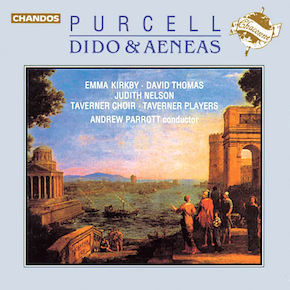
 And so we come to the third in our historical sequence of recordings of Purcell’s Dido and Aeneas. We are talking about Andrew Parrott’s recording with the Taverner Players and Choir recorded at Rosslyn Hill Chapel in 1981. It’s a record that I bought when it first came out and has been a point of reference for me ever since.
It’s a consciously academic affair in some ways. It was produced in conjunction with an Open University course ; “Seventeenth Century England: A Changing Culture”. It’s also musicologically rooted in scholarship. The album booklet even lists the provenance of the instruments used; mostly modern copies of 17th century models and we are told that the work is performed at pitch A=403. The band and chorus are realistically sized; six violins, two violas, bass violin with bass viol, archlute and harpsichord continuo. A guitar is used in some of the dance numbers. The chorus is six sopranos; some of whom do double duty as witches, the Sailor and the Spirit, four tenors and two basses.
Emma Kirkby sings a more or less vibratoless Dido that’s very similar in timbre to Judith Nelson’s Belinda and Judith Rees’ Second Woman. A tenor, albeit with a wide vocal range, David Nelson, is Aeneas and he does characterise the part very nicely. The big vocal contrast among the female voices is Jantina Noorman as the Sorceress. Her dark and mature mezzo stands out without recourse to too much overt witchiness. Emily van Evera and Rachel Bevan, as her sidekicks, are a bit witchier though the latter sings the Sailor’s song very straight. There’s no attempt to make Tessa Bonner’s Spirit anything other than straight soprano.
The band plays with the rhythmic flexibility we have become accustomed to in the early baroque but which was not the norm in 1981. The voices are not particularly operatic. Overall it’s all very clean and straightforward with no great histrionics and even a rather restrained presentation of the final scene including the Lament. There is absolutely no attempt to make it sound like a 19th century opera! I can see it though as the sort of small scale entertainment that a court, much influenced by French practice, especially Lully, but without Louis XIV’s budget would have appreciated.
The recording still sounds excellent. It’s clean and well balanced. It’s been released in various editions over the years but is currently available from Chandos under it’s original catalogue number CHAN8306 as MP3 and CD quality FLAC and maybe as a physical CD.
 operaramblings