
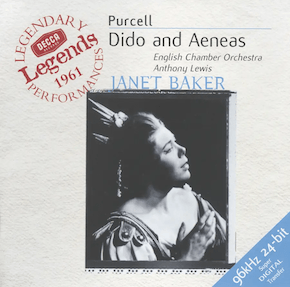
 So, to continue our look at the recording history of Purcell’s Dido and Aeneas we turn to the 1961 Decca recording with Janet Baker in the title role. This has won so many awards and featured on so many “best of” lists that it might reasonably be considered to serve as some sort of “gold standard”. It’s certainly very good but I’m more interested in looking at what it says about the evolution of performance practice of Dido and Aeneas than in adding to the praise for Dame Janet’s performance.
The first thing one notices is that one has come a long way from the 1951 Flagstad recording. The strings are much more rhythmically flexible and lighter even though they are modern instruments. Conductor Anthony Lewis was an early advocate of baroque performance practice and the English Chamber Orchestra seems responsive to that wish. The delicate harpsichord continuo of Thurston Dart contributes too.
The singing too is less “operatic”. I think there has always been, and will always be, some differences of opinion about how clean toned and free from vibrato Dido should be though a brighter Dido tends to mean less contrast between Dido and Belinda. I think the piece works best when there is a clear contrast between the two. So, a light, bright Belinda is fine but then I want more richness in Dido’s voice. Baker and Patricia Clark make a pleasing, contrasting pair while both managing to sound much more modern than Flagstad and Schwarzkopf. Baker, as has been so often said, is simply magnificent in the final scene.
Another issue is how to deal with the humour in the piece. When I look at the literature, especially the plays, of late 17th century England I sense a certain ribaldry, even in court circles. I can’t believe that Purcell and Tate intended the Sorceress and her pals to sing in an overly formal manner. Nor should a sailor taking a “boozy short leave from his nymph on the shore” sound like he’s in a cathedral choir. So, I’m fine with Monica Sinclair, Rhianon James and Catherine Wilson’s more exuberant witchiness and John Mitchinson’s slightly inebriated delivery. I like Raimund Herincx’ fairly characterful Aeneas. It’s a thankless role. One doesn’t need to sound like a plank and he doesn’t. The chorus; the Saint Anthony Singers, get into the mood when required too and sing very well in the more straightforward numbers. Bottom line, if one heard the work presented today as it was in 1961 it wouldn’t feel strange or old fashioned.
The recording is good Decca stereo of the early 1960s. It may not be Culshaw’s Ring but there’s a little bit of sound staging going on in the Spirit’s message delivery for example. It’s worn well. Currently it’s available as a digital release; MP3 and CD quality FLAC, as Decca Legends 4823872.
 operaramblings