
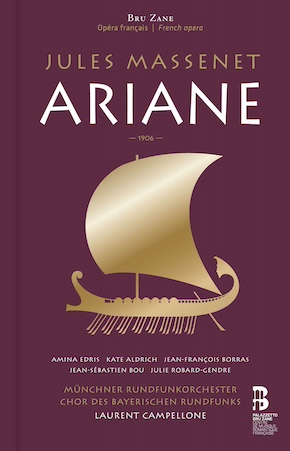
 Ariane is a late opera (1906) by Jules Massenet. Now largely forgotten it has recently been recorded by the Palazzetto Bru Zane in their admirably produced series of French rarities. Unfortunately, unlike some of their other rediscoveries I wasn’t much taken with it.
The plot is an odd take on the Theseus and Ariadne story. Ariadne helps Theseus defeat the Minotaur then sails away with him to Naxos taking her sister Phaedra with them. Phaedra and Theseus fall in love and Ariadne is devastated. When Phaedra learns what effect she has had she curses Aphrodite and attacks a statue of Adonis with a rock. Aphrodite causes the statue to fall on and kill her. This is rather more revenge than Ariadne wants so she goes down to the Underworld and trades a bunch of roses to Persephone for Phaedra. On returning to the light Phaedra vows to give up Theseus but it doesn’t stick and she and Theseus set off for Athens. Ariadne drowns herself.
Musically it’s a bit weird. There are lots of Wagnerian influences; Leitmotifs, portentous low brass, loud crescendos etc but it all sits on a thoroughly French, almost18th century, base with lots of bits that sound like ballets by Gluck and even the odd hint of Canteloube. It’s a bit disconcerting and, frankly, not very coherent.
The recording was made at the Prinzregententheater in Munich earlier this year and uses the Münchner Rundfunkorchester and the Chor des Bayerischen Rundfunks with Laurent Campellone conducting but the soloists are mostly either Bru Zane veterans and/or French. They are well chosen and all sing rather well. The sisters are sung by Amina Edris (Ariane) and Kate Aldrich (Phèdre). The former’s brighter and somewhat lighter voice making a pleasing contrast with Aldrich’s rather more dramatic colours. Jean-François Borras, as Thésée, has the heft of a Heldentenor while still sounding thoroughly French. He also has very decent high notes. Jean-Sébastien Bou is a very sinewy baritone who is excellent as Thésée’s bluff sidekick Pirithous. The young lovers Eunoë and Chromis sound appropriately youthful in the hands of Marianne Croux and Judith van Wanroij. Act 4 also benefits from a really interesting, dark Persephone in Julie Robard-Gendres.
The disk package is to Bru Zane’s usual high standard with a 140 page book containing the libretto and English translation complete with stage directions (which go some way to explaining why this isn’t performed very often). as well as modern and contemporary essays and interviews about the work and its performance history. It’s available as a 3CD set with book or digitally in MP3, CD quality and hi-res FLAC. I listened on CD quality digital files and I rather wished I had had the higher resolution version as there were places where I could have used more clarity. On the other hand the physical version comes with a physical book and a 140 page digital book is a bit of a pain!
I don’t see myself returning to this very often. The plot doesn’t really work and the music is just a bit too schizophrenic for my taste.
Catalogue number: Bru Zane BZ1053
 operaramblings