
Thursday night at the Four Seasons Centre saw the tenth iteration of the COC’s Centre Stage: Ensemble Studio Competition. It’s a competition for young singers for cash prizes and, more opaquely, potential places in the COC’s Ensemble Studio.
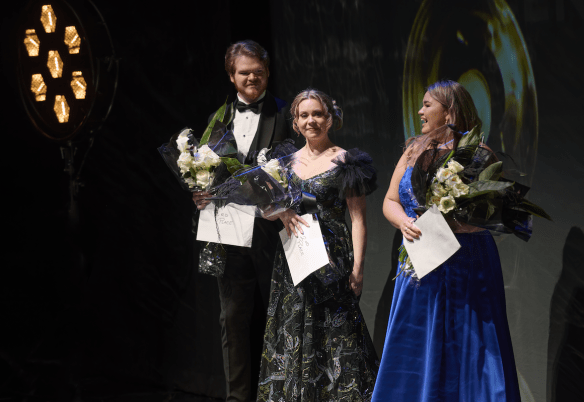
L-R: Duncan Stenhouse, Emily Rocha, Elisabeth St-Gelais

Gabrielle Turgeon
It was very glittery; host Sangita Patel appeared to be wearing a disco ball, and it was hyped up quite a bit; “Opera Stars of the Future”. Realistically, success at Centre Stage is less a guarantee of stardom than an opportunity to get a grip on the very bottom of the long, greasy pole that may, sometimes, lead to stardom. Sure, there are sometimes “stars of the future” competing in Centre Stage but one knows who they are long before the competition! Last night it was fairly open. There was no obvious Emily D’Angelo.
The way it works is that there is a week of work for the finalists with coachings and rehearsals etc and then, come the day, there’s a preliminary round of arias that the public don’t have access to. We only get to see the seven finalists do a single aria albeit with the full COC Orchestra and Johannes Debus. In other words, the judges have far more information than the house audience. After that final round the judges go off and judge and the audience gets to vote for their choice. Given what I’ve just said it’s perhaps surprising that they usually agree! (As they did last night).
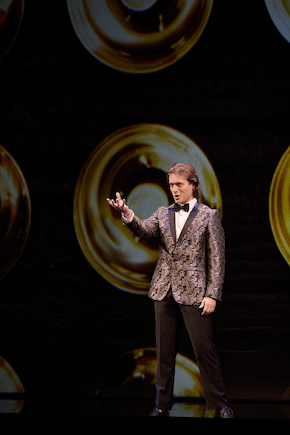
Jamal Al Titi
So what of the seven finalists? They were chosen after an extensive audition process and for the most part they are the most polished products of Canada’s very extensive university/conservatory singer production line. There was Matthew Li (bass) who sang a very nice “Come dal ciel precipita” from Macbeth. Accurate very workmanlike. Fellow bass Duncan Stenhouse, who made the boldest rep choice of the night with the Varangian Guest’s aria from Rimsky Korsakoff’s Sadko, was somewhat similar. Both of these arias should raise the hairs on the back of one’s neck but they didn’t. Still Stenhouse’s performance was good enough to net him 3rd prize.
Unusually this year there were more guys than gals. Besides two basses we got baritone Jamal Al Titi, who I know to be a fine art song singer. He brought those qualities to Onegin’s aria from Eugene Onegin but probably wasn’t operatic enough for this show. I rather liked Matthew Bermudez who is a lyric tenor with genuine high notes and probably enough oomph for bel canto tenor roles. He sang a very nice “Una furtiva lacrima” but it wasn’t enough to sway the judges. FWIW I had him third on my card.

Matthew Li
And so to the ladies; all sopranos. Gabrielle Turgeon made a fairly bold choice with “Piangerò la sorta mia” from Giulio Cesare. If one is to impress with a da capo aria from Handel it’s going to take killer coloratura and at least a hint that one is bold enough to actually ornament the A repeat. It didn’t really happen though it was very decent singing. Then came Emily Rocha with “Caro nome”. It was a good choice. Her coloratura was good, she characterised well and, let’s face it not trivial, she looks the part. I could see her in the classic young lyric rep and I was totally unsurprised when she took second place.
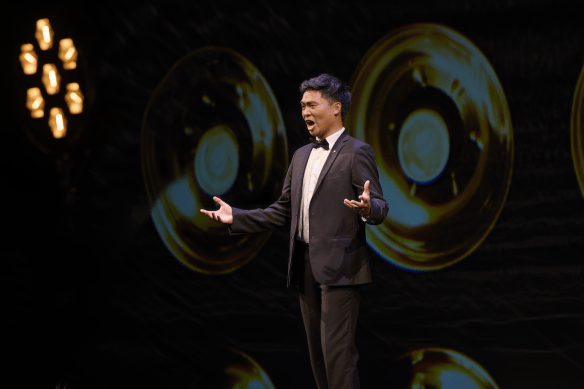
Matthew Bermudez
And so, to the last singer Elisabeth St-Gelais. Pre show scuttlebutt had her among the contenders which based on previous exposure I was pretty much in agreement with. She chose to sing “Vissi d’arte” which was sure to be a crowd pleaser. It wasn’t the most polished I’ve heard but there’s power and richness in the voice that none of the others could match. In other words there’s work to do but there could be a star here. Clearly I wasn’t the only one who felt that and she ran out First Prize and Audience Choice winner. We will have to wait to see who makes the Ensemble Studio.
It was also a curiously low key evening. Much of the glamour has gone (financial pressures no doubt) and there wasn’t a high profile UoT frontrunner so the house wasn’t papered with a noisy claque. Still it’s one more step in getting back to normal. One of the (many) downsides of COVID was that up and coming singers were much less visible than before so the return of opportunities to see whose coming through the system are very welcome.
Photo credits: Michael Cooper
 operaramblings