
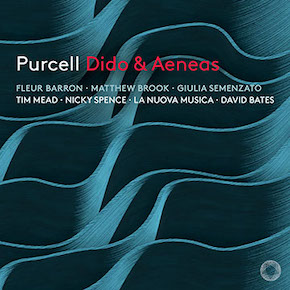
 This new CD recording of Purcell’s Dido and Aeneas sets out to produce a version that might have been heard at court in the early 1680s. This is, of course, one of several theories about the work’s genesis and it’s the one I find most credible. Taking this as a starting point allows music director David Bates a framework in which to consider issues of style and casting.
He posits significant French influence, which I would take as pretty much a given, but also some Italian flavour, which is a new idea to me and I think, too, that it’s clear that the Anglican choral tradition influences the choruses. So what does he do with these premises? First, and perhaps most importantly, he casts a rather dramatic mezzo, Fleur Barron, as Dido and encourages/allows her to present the role as if it were perhaps la grande tragédienne from one of Lully’s tragédies lyriques. Paired with the light, lyric soprano Giulia Semenzato as Belinda it produces an effect that strongly reminded me of Meghan Lindsay and Mireille Asselin in the recent Opera Atelier production though Semenzato ornaments more than most Belindas (and does it very well).
The French influence also results in rather more woodwind in the instrumental ensemble and the Italian touch is to include a harp in the continuo group. The other notable stylistic choice is that contralto Avery Amereau, as the Sorceress, and her two sidekicks; Helen Charlston and Martha McLorinan, sing in a less exaggerated “witchy” way than is sometimes the case.
The gentlemen are pretty good too. Matthew Brook sings Aeneas with a fair amount of emotional expressiveness. He’s a genuine bass-baritone and I like the darkness that brings. Nicky Spence is rather luxury casting as the Sailor and like the witches he plays it pretty straight rather than as if he’s three sheets to the wind. Countertenor Tim Mead sings his cameo as the Spirit very nicely.
The chorus sings with a very pure sound as one might expect from the Gentlemen of the Chapel Royal and, perhaps, whoever formed the female element of the chorus back then. There are a couple of other neat touches that I enjoyed. The dance music that precedes “oft she visits” is wonderfully jazzy; the instrumentalists of La Nuevo Musica clearly get that link between jazz and baroque style, and there’s really interesting use of percussion in both the first witches’ scene and the sailors’ dance.
All in all this version of Dido and Aeneas sounds rather different from any of the many other versions I’ve heard but I think all the stylistic choices are historically justifiable and I rather like the final product. Whether it will suit all tastes I’m not sure but I can pretty much guarantee that a close listening will at least have the listener asking a few questions or having a few preconceptions shaken up a bit.
There is a good description of what Bates is doing in the CD booklet along with full text, though that’s hardly necessary. The recording, made in St. Jude’s Church, Hampstead Garden Suburb in 2022 is nicely balanced and solid. It’s due for a physical CD (standard res) release on September 22nd. I don’t think there’s a downloadable option.
Catalogue number: Pentatone Records PTC5187032
 operaramblings
The story’s themes of love versus duty, and the clash between personal desires and political obligations, resonated deeply with courtly life. Nobles could readily see parallels between Dido’s struggle and their own complex navigations of power and romance.