
Opera is full of patriarchy. It’s a bit odd then that Leoš Janáček wrote two operas about dominating matriarchs and the consequences of their actions. The better known of the two is probably Jenůfa but the later Kát’a Kabanová deals with similar themes. Both are bleak and have watery endings.
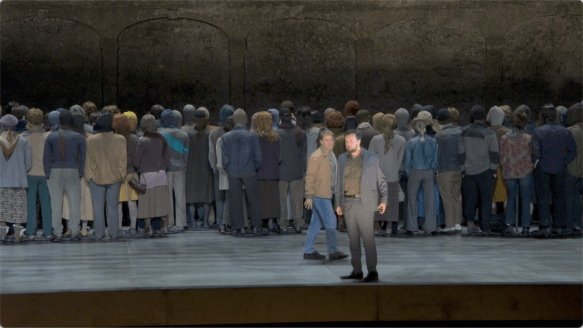
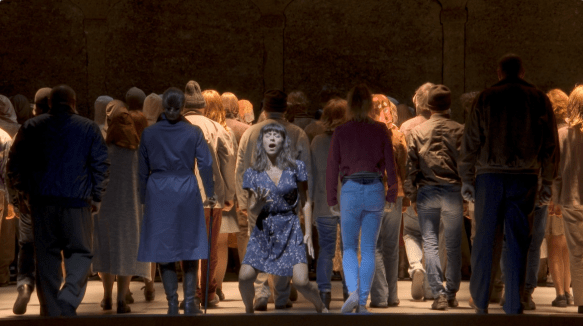
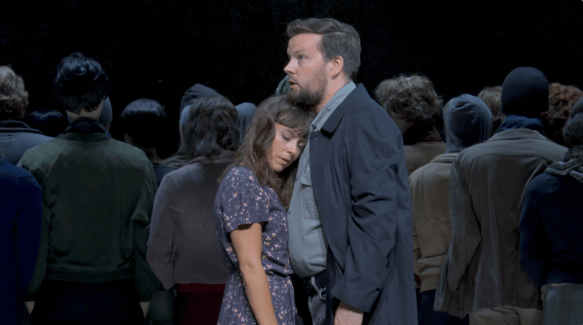
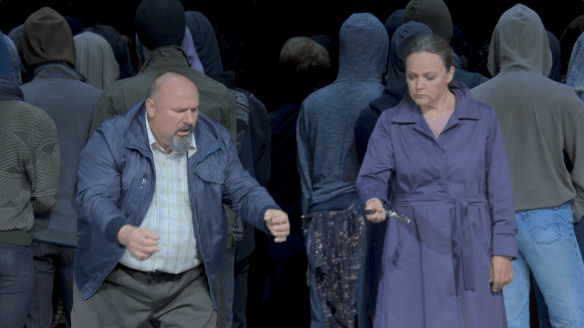
For his production of Kát’a Kabanová at Salzburg Barrie Kosky appears to be using the vast, blank stage of the Felsenreitschule to create a sense of alienation; that Kat’a is out of place in the situation she finds herself in; a marriage dominated by her mother-in-law. At the beginning the full width of the back of the stage is covered in mannequins facing away from the audience, and Kat’a. As the scenes progress these mannequins, sometimes supplemented by chorus or extras, are used to reshape the stage area. So, for example, at the beginning of Act 3 Kát’a is hemmed into a small space by a wall of oblivious bodies. Other than the mannequins there is no other backdrop than the bare, grey walls of the theatre.
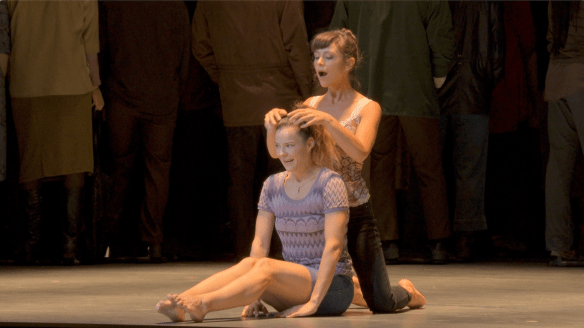
As always with Kosky productions there’s lots of movement and action This is particularly true of the character Varvara, played by Jarmilla Balážová who is extremely athletic! There’s lots more coming and going. But ultimately Kát’a Kabanová is about Kát’a’s relationships with the other characters (and God) and the way those relationships play on her mental state. It’s a complex journey and here it’s well navigated by Corinne Winters who exhibits a wide range of moods depending on the interaction.
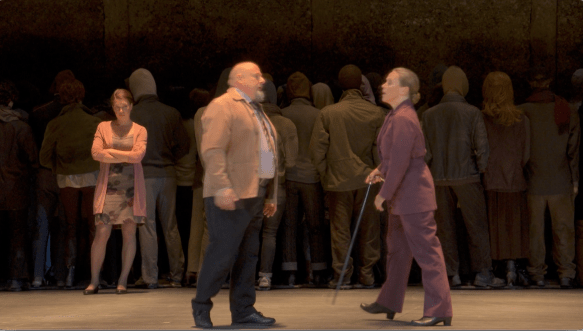
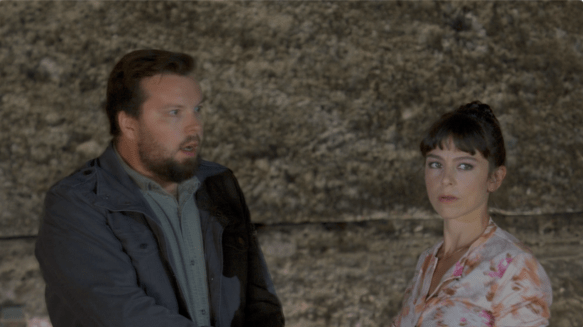
She’s at her most vulnerable in the triangle with her rather feeble husband Tichon (Jaroslav Březina) and his overbearing mother Kabanicha (Evelyn Herlitzius). Like her counterpart Kostelníka in Jenůfa she’s driven by a brutally Calvinistic sense of sin and hierarchy and is thoroughly unpleasant. Herlitzius capture this in an utterly compelling manner. With Varvara Kat’a is quite girlish and unaffected and comes over in manner and dress as someone who doesn’t quite realise that she’s a married woman in a conservative community. This is prefigured in her aria about how and why she loved going to church before she was married. With her lover Boris (David Butt Philip) she appears torn between guilt and finding someone, at last, she can relate to. Then, of course, there’s her breakdown and confession followed by her suicide (staged very simply and effectively!). Through all this Winters is believable and sings beautifully. It’s a very fine performance.
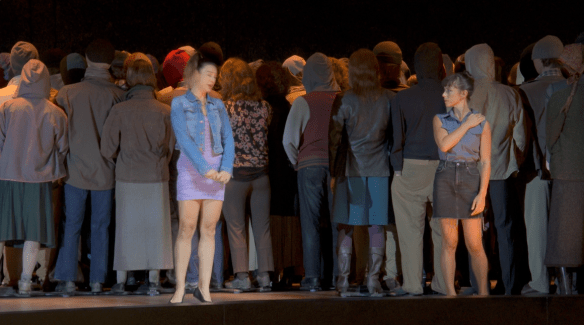
There’s nothing much else to the production. It’s simple but effective. The one place Kosky has a bit of fun is in the relationship between Kabanicha and the brutish Dikoj (Jens Larsen). She has him on a leash in his underwear and she’s feeding him sausages, as well as humiliating him in other ways. In this light it’s hard not to see Kabanicha’s need to humiliate her children and daughter in law through some sort of perverted sexual lens.
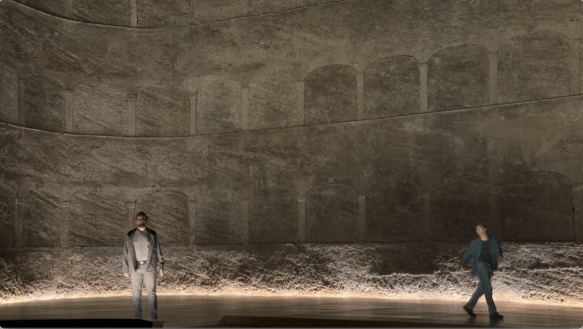
Besides fine performances from Winter and Herlitzius there’s excellent singing and acting from all the principals. David Butt Philip shows again that he’s one of the finest young tenors around with a youthful, full, bright sound. Also fine acting. Jarmilla Balážová is quite charming and has a good voice and she’s well partnered by Benjamin Hulett as Kudrjáš who also has a pleasant, youthful tenor. Larsen and Březina make the most of their rather unsympathetic roles.
No Janáček opera is entirely satisfactory without really good orchestral playing and insightful conducting. It gets both here from the Vienna Philharmonic, sounding as detailed and refined as ever, and conductor Jakub Hrůša. The chorus, from the Vienna State Opera, doesn’t have a lot to do bur what they do have they do well. All in all this is musically very idiomatic and satisfying.
Video direction is by Felix Breisach. It’s never easy to film in the Felsenreitschule as any sort of scene setting shot has an absurd aspect ratio. That said he does enough to make clear what Kosky is getting at and generally there’s nothing weird about the cinematography except perhaps for a strange concentration on Kát’a’s hands when she’s making out with Boris. On Blu-ray the picture is fine. Even long shots in the dark Act 2 come out quite well. Sound too; the usual hi-res stereo and DTS-HD-MA, is very good and clear. The booklet has an essay, a synopsis and a track listing. Subtitle options are English, French, German, Spanish, Korean and Japanese.
There aren’t actually any video recordings of Kát’a Kabanová currently available (this one is due for release August 25th) and the excellent Robert Carsen Madrid production seems to be out of print. Even if it were available the new one would still be a strong contender. It’s a careful, thoughtful production, well realised both on stage and video.
Catalogue number: Unitel Blu-ray 809204
 operaramblings