
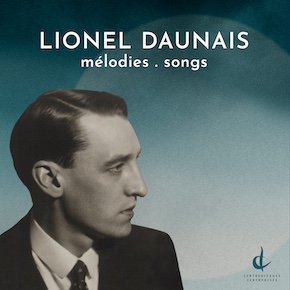
 This recent Centrediscs release contains 27 songs (a generous 76 minutes of music) written by Québecois singer and composer Lionel Daunais in the mid 20th century. The songs really fall into two distinct groups. Some are art songs written for concert hall performance while others are works in a more popular style written for a wider audience. The art songs are very French; the others distinctly of Quebec.
The art songs set quite a wide range of texts but there’s a definite leaning towards the symbolist poets of the early 20th century. There’s some Tristan Klingsor and more Paul Fort; a poet rather under-represented in song given his stature and huge output. There’s even one text in similar style written by Daunais himself. Besides the symbolists there’s some Ronsard and Boileau and even a translation of a 13th century Arabic text. There’s some variation in these songs but a strong tendency to languorous settings of poems about unrequited love though sometimes the subject matter becomes more surreal as in Fort’s “Le diable dans le nuit” or the setting more up tempo as in the anonymous “L’innocente”. In many ways these Daunaissongs are not very different from much of the output of composers like Poulenc or Duparc. Fans of that style of chanson will likely enjoy these songs too.
The more popular idiom is a bit harder to describe. Daunais was a founder of the Trio lyrique; a group that performed in concert but also extensively on the radio between 1932 and 1960. They sang covers of popular hits, folk songs and humorous songs where Daunais contributed both text and music. These are gently humorous, working with themes familiar to their listeners. For example there’s one about a curé who loses things, another about a sacristan’s many tasks and a very silly piece about a shoemaker who is so distracted by his comely customer that he hits his own hand with his hammer. But that’s about as risqué as it gets. The music is rhythmic and bouncy, occasionally with jazzy elements, and it often supports slightly bizarre rhyme schemes. The curé song, “Monsieur le curé”, for example, finds a rhyme for “Dominum nostrum” in either French or Latin in every verse. The bounciness, rhythmic nature and rhyming remind me in a weird way of a vastly more respectable (and bourgeois) George Formby. The songs are often set, as one might expect, for two or three voices in a sort of “call and response” style. They are enjoyable though there are times when a working knowledge of Québecois idiom is useful!
The performances from soprano Jacqueline Woodley, mezzo-soprano Annina Haug and baritone Pierre Rancourt with pianist Marc Bourdeau and a cameo from flautist Michel Bellavance are excellent. The singing and playing is all idiomatic and appropriately adaptedto the different styles of the materia. French diction is top notch. The recording is excellent and there is quite full documentation with lots of useful material on Daunais’ career and his songs. Full French texts are provided but not translations.
This is a good way to explore the output of a composer who was never much heard beyond the confines of Quebec and French language radio and probably is even less often heard today.
Catalogue information: Centrediscs CMCCD 30122
Tghius review first appeared in the Summer 2022 edition of Opera Canada.
 operaramblings