
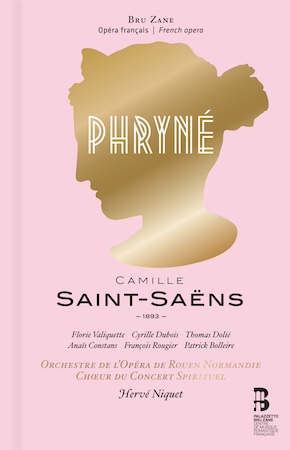
 The latest release in the CD/book series from the Palazetto Bru Zane is Saint-Saëns’s 1893 opéra comique, Phryné, loosely based on an incident in the life of the famous 4th century BCE courtesan. It’s a two-act piece lasting about 65 minutes. The original was given with spoken dialogue, but as so often with this genre, recitatives (here added by André Messager in 1896) have been used in this recording, as they were in most contemporary performances.
The plot is straightforward enough. Dicéphile is a rather pompous magistrate and has just been honoured by the city with a bust. His nephew/ward Nicias is in love with Phryné, but also broke and about to be arrested for debt. With the help of Phryné’s servants, he beats up the officials sent to arrest him and hides in her house, where, after the usual confusion, she admits to being in love with him. Dicéphile shows up to find that his bust has been disfigured with a wineskin and remonstrates with Phryné, who quickly changes the subject to her upcoming trial on a charge of impiety. Dicéphile is overcome by her (obvious) charms and agrees to drop the charges. He also agrees to share his fortune with Nicias and all live happily ever after.
There’s a clever and controversial element in the staging, which, inevitably, turns on just how Phryné displays her charms. History suggests that her lawyer bared one (or both) of her breasts during her trial before the Areopagus, arguing that it would be an insult to Aphrodite to condemn such beauty. But there’s also an 1861 painting by Jean-Léon Gérôme that shows Phryné fully and embarrassedly naked in the same situation. The painting was much reproduced at the time and may have been more familiar to the audience than the historical version (though surely not to as knowledgeable a classicist as Saint-Saëns).
In any event, the problem is overcome in the staging by the lights going down briefly, except on a statue of a naked Aphrodite with the features of Phryné (a reference probably widely understood at the time to Praxiteles’s Aphrodite of Knidos).
As an opera, or perhaps really an operetta, it’s very enjoyable. It’s light and tuneful and only rarely gets “heavy” or “grand.” There are very pleasant duets and ensemble numbers. The orchestration is skillful. It does not, though, have the exuberance of Offenbach, despite taking a classical theme as lightly as he does. Reynaldo Hahn might be a better comparison. It’s odd to think that it premiered just a few days after Die Walküre first appeared in Paris.
The recording was made with a cast of francophones backed up by the Choeur du Concert Spirituel and l’Orchestre de l’Opéra de Rouen-Normandie conducted by Hervé Niquet. It’s a well-chosen cast, with splendid diction and all sounding very French. Québécoise Florie Valiquette in the title role sings with clear and rather beautiful tone, displaying crisp coloratura on the couple of occasions it’s needed and rising to the challenge of the work’s “grandest” air, “Un soir j’errais sur le rivage.” The light and very French tenor of Cyrille Dubois is an excellent foil, while Thomas Dolié, as Dicéphile, manages to sound suitably pompous without going over the top. The minor roles are well done and Niquet produces some very stylish music-making from all concerned.
The studio recording is excellent and, this being one of the Bru Zane series, the documentation is fulsome, running to some 60 pages in each of English and French. It’s available physically as 2 Cds with book or digitally, with digital booklet, in MP3 or FLAC (CD quality and 96kHz/24 bit) formats. I reviewed from CD quality digital. All the issues noted in this review are covered at length, along with everything from the German Romanticism vs French Classicism controversy in 19th-century France to Plato’s Theory of Forms.
All in all, an interesting and rewarding release.
Catalogue information: Palazetto Bru Zane BZ1047
This review first appeared in the Spring 2022 edition of Opera Canada magazine.
 operaramblings