
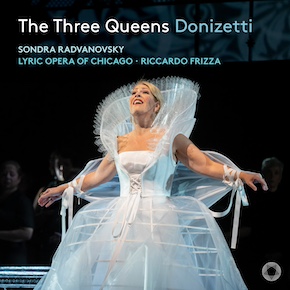
 Donizetti’s three “Tudor Queen” operas; Anna Bolena, Maria Stuarda and Roberto Devereux (of which, despite the title, the real star is Elizabeth I) are often seen as a sort of trilogy and have occasionally been performed as such with a single soprano starring in all three. It’s a feat Sondra Radvanovsky managed at the Metropolitan Opera in the 2015/16 season. It’s not particularly surprising then that she should have been sought after by Lyric Opera of Chicago to star in a show featuring the final scenes of each opera which was recorded live at the Lyric in December 2019.
The format of the two disk set is that the overture of each opera is followed by its final scene. Radvanovsky sings the queens while the supporting roles are taken by members of the Lyric’s young artists programme. Riccardo Frizza conducts with the house orchestra and chorus. The minor roles are well done, the orchestra and chorus are just fine and Frizza is obviously at home in this music. But it’s the Radvanovsky show and her singing carries the whole thing.
It’s very fine bel canto singing. All the elements one would wish for are there and come together to form a harmonious whole. To illustrate different aspects of her artistry I have chosen a “big number” from each of the three operas. In Anna Bolena it’s “Al dolce guidami castel natio” where Anne, semi-delirious, recollects her happy childhood home (she obviously hasn’t read Wolf Hall). Here we hear a voice of very pure tone with very clean high notes and smooth, well managed runs. Moving on to Maria Stuarda there’s “Ah! se un giorno” where the singer has to navigate singing against, at times, fairly heavy choral and orchestral forces. Here, the principal voice is distinct and Radvanovsky, apparently effortlessly, projects some serious high notes over the ensemble. Her ability to sustain a note for some considerable time is also evident. Finally, “Vivi ingrato” from Roberto Devereux shows Radvanovsky dealing with a moment of high drama and emotion. What I appreciated here is that she’s dramatic but not mannered. There’s no exaggerated sobbing but rather a beautifully and subtly shaped vocal line. I think this really matters in bel canto. It’s a common criticism of the genre that often the music doesn’t really reflect the seriousness of what’s going on with rumpty-tumpty marches to the scaffold and so on. There’s truth in that and, I think, artistically, the best way to deal with it is with a purity of vocal acting that matches the music and that’s what we get here. All in all, this is very classy, craftsmanlike singing.
Turning to the other aspects of the disk, it’s technically very clean and well balanced, especially for a live recording and there’s no intrusive stage noise either. The accompanying booklet is well put together with useful introductory material and full texts and translations. It’s a fitting package for a very fine performance. It’s available physically as 2 Cds with booklet or digitally, with digital booklet, in MP3 or FLAC (CD quality and 96kHz/24 bit) formats. I reviewed from CD quality digital.
Catalogue information: Pentatone PTC 5186970
This review first appeared in the Spring 2022 edition of Opera Canada magazine.
 operaramblings