
1939, written by Jani Lauzon and Kaitlyn Riordan and directed by Jani ,opened last night at Canadian Stage’s Berkeley Street theatre. The setting is a Residential School in Northern Ontario which is set to host the King and Queen as part of their 1939 tour of Canada. The Welsh, but fiercely anglophile[1], English teacher decides that putting on a production of Shakespeare’s All’s Well That Ends Well would be suitable fare for the royals.
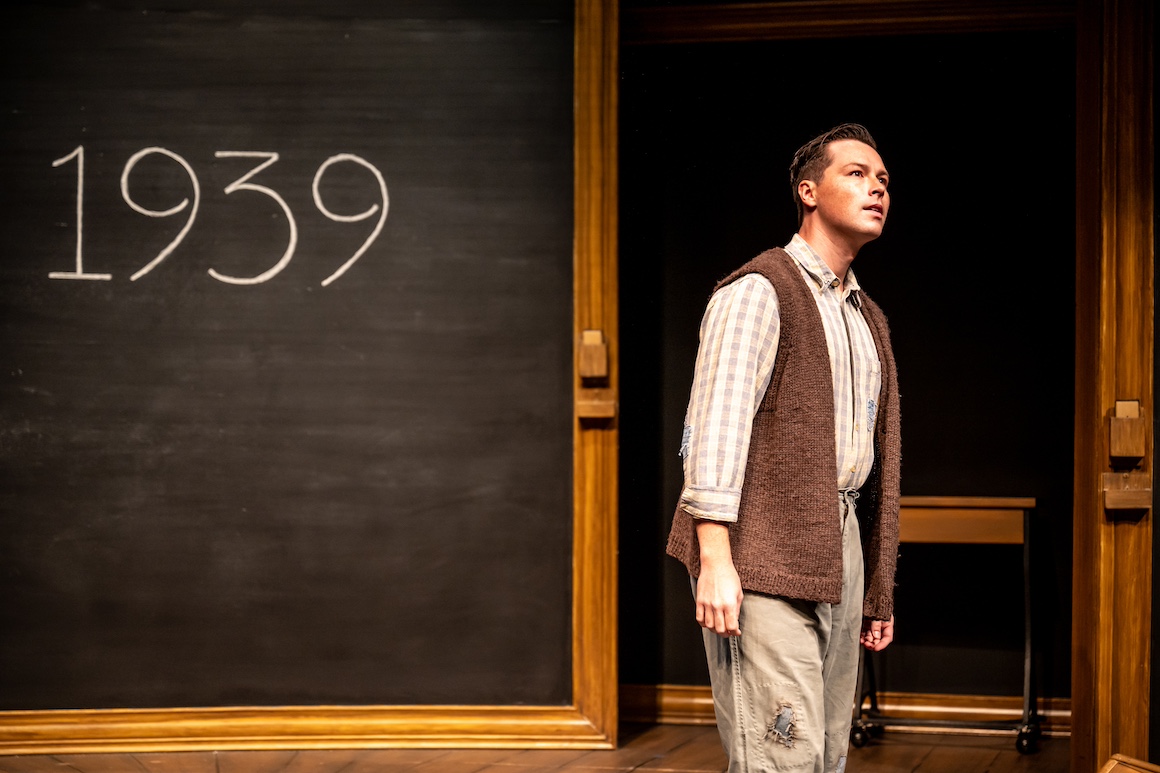
This basic frame is used to create a play that’s simultaneously a comedy about clashing cultural values and a thought provoking exploration of both Indigenous and Settler Identity in a country slowly and tentatively emerging from English cultural hegemony. It never forgets that it’s set in a Residential School though. From first scene to the last the cruelty of a system designed to erase Indigenous identity is present. Neglect, physical and psychological violence, hunger and fear are never very far away. The coming war also makes it’s presence felt.

Briefly, the long time English teacher Sian Ap Dafydd, played by Catherine Fitch, aspires to create a very English Shakespeare production à la Ellen Terry. Ironically, of course, this would be as out of whack with the contemporary theatre in the UK as the first productions I saw at Stratford in the 1980s were! This is way beyond the skills of either her pupils (except for her “star pupil” Beth Summers, played by Grace Lamarche, who seems to have memorised the Complete Works and who is cast as the Countess) and Father Williams (Nathan Howe), the hockey coach who is enlisted to boost male numbers; there being so few male pupils who can read English at all.

The rehearsal process has Miss Ap Dafydd desperately fighting back against any suggestion that the players might introduce any elements of their culture into their characterisations despite Dame Ellen’s invocation to find oneself in a Shakespeare role. The goal is to prove that Canadians, including the Welsh ones, are more English than the English. The applecart is upset when a female Ottawa reporter Madge Macbeth (Amanda Lisman) visits and subsequently profiles the project in the Ottawa Citizen. For her, this “Indian Shakespeare” represents everything that’s culturally progressive in the Dominion; especially compared to the lack lustre Dominion Shakespeare Festival!

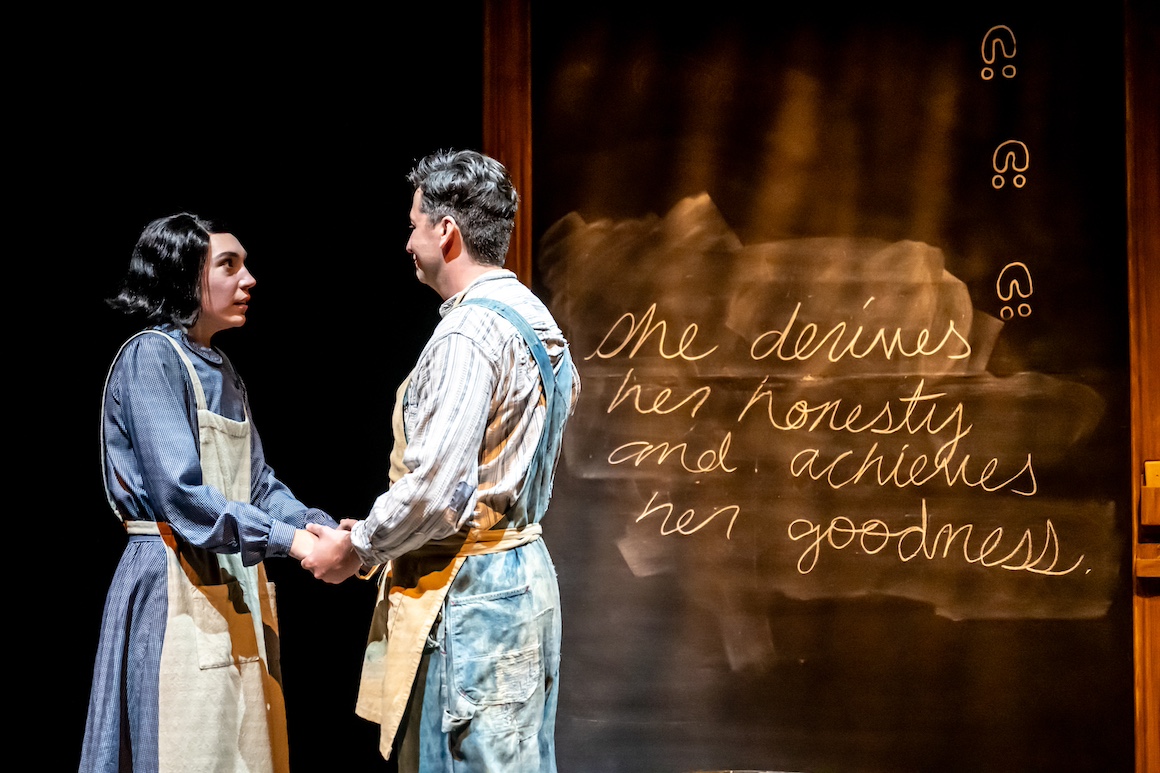
With public interest mounting Ap Dafydd is forced to turn to her pupils; especially the Mohawk girl with a fount of traditional healing lore Evelyne Rice (Merewyn Comeau), who is playing Helena, and the “half breed” Jean Delorme (John Wamsley) playing Paroles who work out a scenario in which Bertram; played by Beth’s “traditionalist” brother Joe Richard Comeau) has defected to the local Settlers and is helping them steal Cree land. But, of course, the audience must get Indians as they imagine them so the costumes, provided by the local Women’s Auxiliary look like cut price versions of the costumes from a 1950s cowboy movie and horrify the actors.

So, after much hilarity and many disturbing reminders of the setting we move to the night of the performance. Fragments of the play, in impeccable English, are played over scenes of the actiors rushing around in silly costumes carrying “typically native” cardboard cut out props; a canoe, a “wigwam”, a camp fire and so on. So cut to the final scene where Father Williams as the King of France, who is supposed to be channeling Louis Riel, succumbs to his weakness; a tendency to extreme flatulence when nervous. Delorme steps in to save the day. The cast ditch the silly costumes and play out an excellent version of the final scene with an impressive contribution by Susan Blackbird (Brefny Caribou) playing Lavatch. It culminates in Evelyne giving Helena’s final speech in Kanienʼkéha. The king and queen, predictably, are no shows.

In a kind of coda the cast talk about their futures. Beth will “assimilate” and become a teacher. Joe will return to the Reserve. Jean will make propaganda films for the National Film Board. Susan will acquiesce in the marriage arranged for her by the school principal and move to town. Evelyne will become an army nurse in the coming war hoping to fuse her traditional knowledge with Western medicine. But we are not allowed to forget where we are. Evelyne has had her head shaved for using her own language in the play. But we do see a glimmer of a future where there are options other than the Reserve or becoming “good little (English) Canadians”.

There are some other clever touches along the way. In particular the use of The Maple Leaf Forever [2], with appropriately rewritten lyrics to open and close the play. There’s extensive use of three blackboards on which quotations and messages are written and erased and which finally feature Indigenous symbols that father Williams can’t erase! There’a really effective sound design (Wayne Kelso) which keeps the momentum up during the many (slickly executed) scene changes.

Above all, an excellent ensemble cast who manage to shift gears between classy Shakespearian acting, a more naturalistic style snd some splendid parodying of a much older way of playing Shakespeare bring to life a cleverly written and directed play that combines raucous slapstick comedy (so many fart jokes) with a multifaceted exploration of Settler and Indigenous identity in transition without losing sight of the horror that was the Residential School System. It’s a compelling two and a half hours of theatre.
1939 runs at Canadian Stage’s Berkeley Street theatre until October 12th.
fn1: There’s a nod to the attempt to erase the Welsh language in schools here. It does explain Ap Dafydd’s extreme assimilation to “Englishness” as a way of coping but it seems uncomfortably like an equation of what happened in Wales with the Residential School system.
fn2: I do wonder how many people will even recognize The Maple Leaf Forever, or it’s cultural significance. It seems to be one of those once cultural icons that’s been banished to the Valley of Lost Things. It’s use, and abuse, here though is very clever.
Photo credits: Dahlia Katz
 operaramblings