
Mohammd Yaghoubi’s Earworm, currently playing in the Studio Theatre at Crow’s, is a hard hitting story of what the Islamic Revolution has meant for Iranian women. Unfortunately it hangs onto to more ideas than the narrative can comfortably support which diffuses the impact.
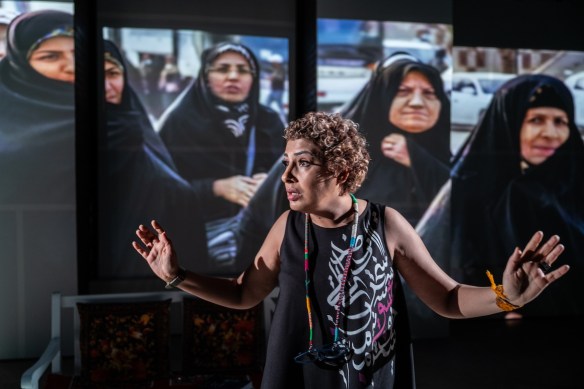
It’s the story of Homa, a woman who has emigrated to canada with her young son after the execution of her husband and a five year stay in a women’s prison in Iran. There are two versions playing; one in Farsi, one in English. The author’s notes say that the two versions were written concurrently rather than one being a translation of the other but the English version does feel rather like a translation. I don’t know any dialect of English for instance where someone would say “get naked” when they want someone to take their shirt off.
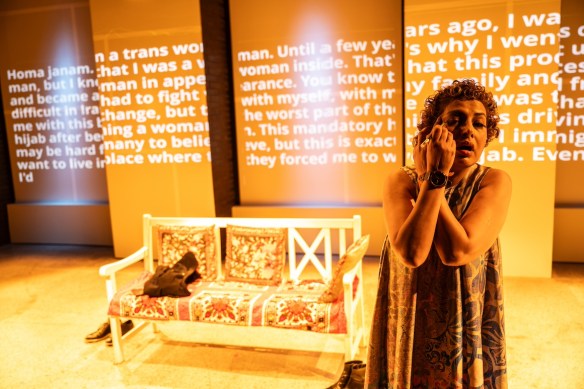
Where it gets a bit messy is that it’s part monologue about the condition of women in Iran complete with some very effective video projections. There’s also a story that this is hanging on. Homa’s son Pendar is planning to marry Fatemeh whose, father, Mohammad, we are told, is religious. Homa is scheduled to visit them. This leads to long arguments with Pendar about whether she should wear a scarf etc etc which serve as more pegs on which to hang discursive material about how the status of women changed in Iran after the Revolution, as well as some humour. Eventually Homa makes the visit and dramatic events involving a series of coincidences unfold (cut for spoilers but let’s just say it involves her experience in prison in Iran). Slightly implausible coincidences don’t really bother me. I know they do actually happen. But here they are perhaps too central.

There’s also an element of audience participation. One is a straw poll on whether Canada is a “free country” that doesn’t go anywhere and seems entirely superfluous though it’s an interesting question. The other appears to be letting the audience pick which of two “horror stories” about women’s lives in Iran they will see. I’m not sure this adds much either. There’s also been some updating on the fly to keep up with events in Iran which leads to some rather clunky structural issues.
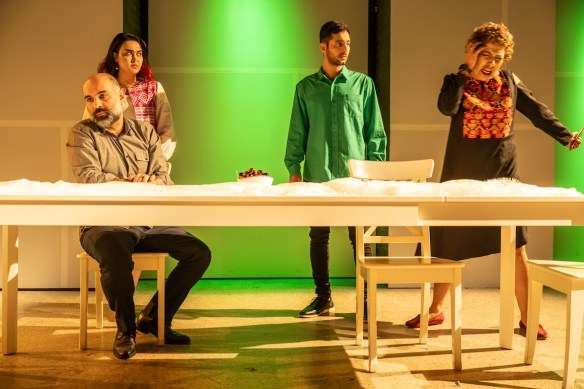
It’s well directed by the author and there are good performances, particularly from Aida Keykhali as Homa and Amir Zavosh as Mohammad. Both Amir Maghami, as Pendar, and Parya Heravi, as Fatemeh, seem a bit stiff and awkward. That may be the script and they might seem more natural in the Farsi version (which, of course, I haven’t seen). It’s definitely helped by being in the very intimate space of the Studio Theatre but, bottom line, despite Earworm addressing an important issue and a fine performance from Kevkhali, I felt unsatisfied at the end. Too much extraneity, an element of implausibility and, above all, a sense that the author couldn’t quite make up his mind about the focus of the work rather marred the experience.
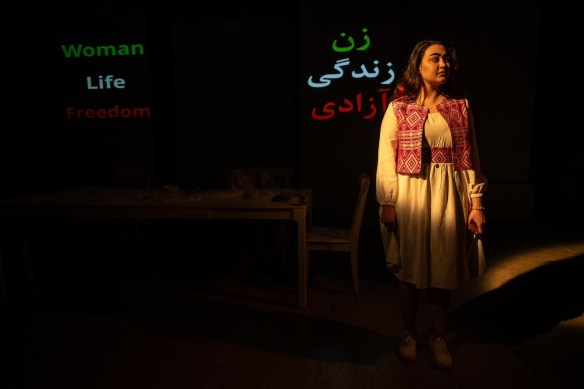
Earworm runs in the Studio Theatre at Crow’s until February 25th with select performances in Farsi with English surtitles.
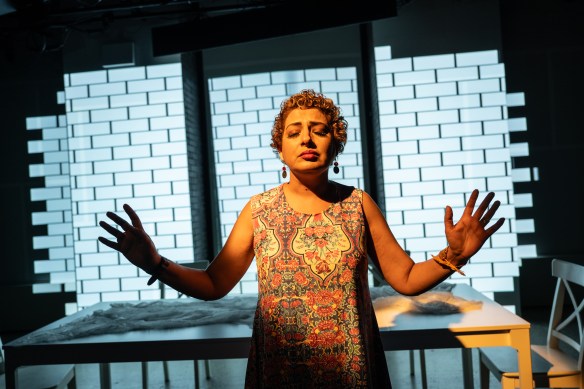
Photo credit: Dahlia Katz
 operaramblings