
Heinrich Schütz’s 1636 work Musikalische Exequien is sometimes described as the “first German requiem”.. It was performed last night at Koerner Hall by the excellent LA Master Chorale and their conductor Grant Gershon in a staged version directed by Peter Sellars; following up on their 2020 performance of the Lagrime di San Pietro.

It’s a work in three parts and they aren’t the sections of the mass one might expect in a requiem. The first part “Concert in Form einer teutschen Begräbnis-Missa” does draw on the Kyrie and the Gloria but most of the rest is text drawn from (Lutheran) scripture. The second part is a motet “Herr, wenn ich nur dich habe” and it finishes with a version of the Nunc dimittis; “Canticum B. Simeonis: Herr, nun lässest du deinen Diener in Frieden fahren”.

Stylistically it shows both northern and southern European influences. It’s polyphonic for the most part but there are lots of short “arias” for one or two singers. The music is beautiful and the text, dealing almost exclusively with death and salvation, seems more personal than the Latin mass. Instrumental accompaniment is confined to a portative organ and viol da gamba. The overall effect, especially when sung beautifully in the rather special acoustic of Koerner Hall is very moving.
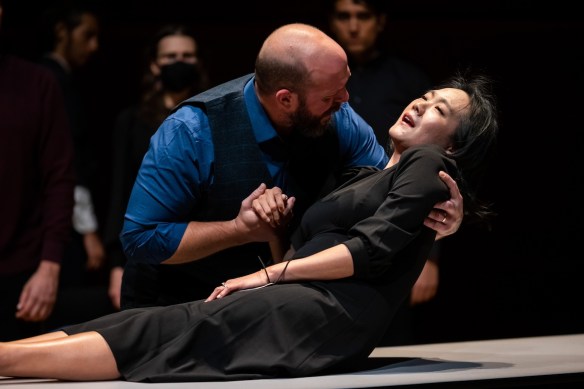
The staging is very Sellars. The singers are in street clothes. At the beginning they appear to be gathering (silently) for a funeral and there are rows of chairs. A sort of bed is used for many of the “arias” in the first part of the programme. Two or three singers emerge from the choir and perform as if one were dead or dying and the other(s) grieving or giving comfort. The choral sections involve lots of movement and shifting patterns and a fair amount of “Sellars semaphore”. For the final part, part of the choir relocates to the balcony. The staging, albeit (necessarily) quite abstract adds more than just visual interest. It creates another dimension in which the core emotions of the piece; essentially grief and hope, can be expressed. It makes the experience more profound than just watching a choir in serried ranks. All in all very beautiful and quite moving.

The photos, by Brian Feinzimer, are from rehearsals not last night’s performance.
 operaramblings